Can we talk about this for a second?
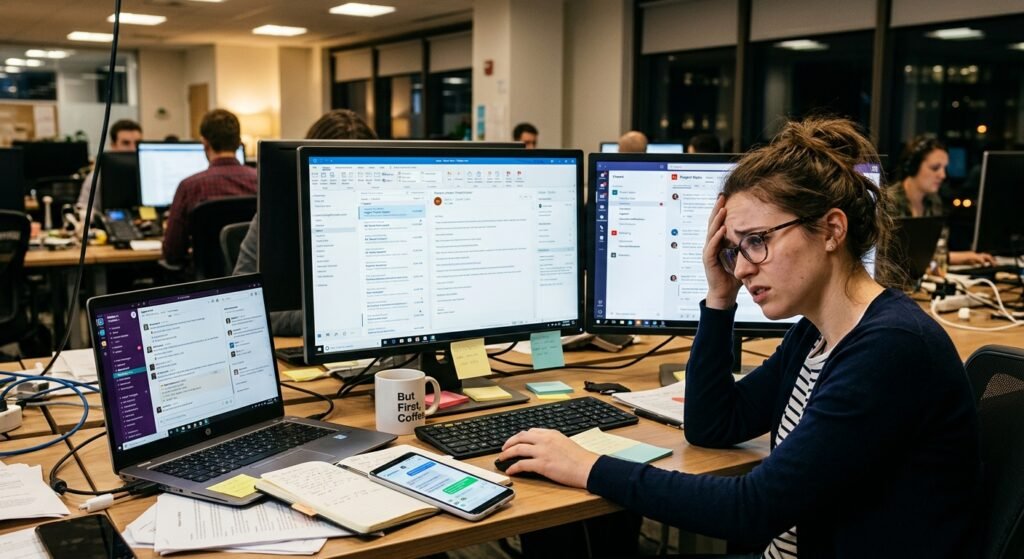
You sit down at your desk, take a sip of coffee, and open your laptop with the best intentions. You have one specific task you want to finish before lunch. It’s a big project, and you’re ready to focus. But before you can even open the document, you notice the dots.
There’s a red dot on the colorful chat app. There’s a red dot on the email icon. There’s a little green dot on your browser tab, and a flashing notification on your phone. Somehow, in the eight hours you were asleep, the entire digital universe decided they needed your immediate attention.
You tell yourself you’ll just clear the dots first. It’ll take two minutes, you think. You’ll just click them so they go away, and then your mind will be completely clear to do the actual work.
This is the first little story we tell ourselves every morning, and we all know how it ends.
The Digital Scavenger Hunt
Two hours later, you’re still staring at the screen, but now you’re in the middle of what feels like a high-stakes search party. Someone asks you for a link. They sent it to you yesterday. You remember seeing it. But where?
You check your email. It’s not there. You search the main chat channel. Nothing. You open the other group chat, the one you only use for specific projects, but it’s empty. Then you remember there’s a shared document somewhere with a list of links, but you can’t find the invite to the document. You end up staring at your screen, clicking between five different tabs, hoping that if you switch between them fast enough, the answer will magically appear.
At some point, it stops being about the actual link. You start reading threads from three weeks ago. You find yourself looking at a conversation about what everyone had for lunch last Friday, and suddenly you’re deeply invested in whether Steve ever got his burrito.
We do this because clearing notifications feels like progress. Each little click gives us a tiny feeling of satisfaction. We tell ourselves we’re being highly communicative and collaborative. In reality, we’re just moving digital paper piles from one side of our desk to the other.
The Multi-App Dance
Then there’s the dance of the modern workplace. You receive a message on one platform. It says, “Did you see my email?” You open your email, find the message, and reply. Two minutes later, the person pings you on a third platform to tell you they saw your reply to their email, but they want to jump on a quick video call to discuss it.
For some reason, this suddenly feels completely reasonable. We’ve created a world where we need three different conversations on three different platforms just to agree on when to have a fourth conversation. We’re constantly translating between different styles of communication. On email, we’re formal and polite. On the chat app, we use custom emojis and exclamation points to prove we’re not angry. On the project board, we write short, mysterious phrases that sound like we’re secret agents.
It’s exhausting, but we keep doing it because we want to look available. We want our little green status light to stay bright green so everyone knows we’re definitely at our desks, definitely working, and definitely not looking out the window wondering if we should buy a bread maker.
The Art of the Status
We even have a whole system for managing our availability. You set your status to “Focusing” with a little headphone emoji. This is your way of telling the world you’re in the zone. But five minutes later, you see a message pop up in the corner of your screen. You know you should ignore it. You literally just told everyone you’re focusing. But the temptation is too strong.
You sneak a quick look. It’s a question that you can answer in ten seconds. You answer it. Then you feel a little guilty because you broke your own rule. So you change your status back to active, and the whole cycle starts over again.
Nobody talks about how much energy we spend just managing the tools that are supposed to save us energy. We’re like air traffic controllers, but instead of planes, we’re guiding endless streams of feedback, updates, and memes to their proper destinations.
We convince ourselves that we can handle all of it at once. We tell ourselves that we’re great at multitasking. We believe we can write a report, participate in a group thread, monitor our inbox, and keep an eye on a shared document without losing our train of thought.
A Warm Reality Check
But the truth is, sometimes the most productive thing we can do is just close the tabs. Not forever, of course. We still have to do our jobs. But maybe for just one hour, we can let the red dots pile up.
The messages will still be there. The links will still be lost in some forgotten folder. And Steve’s burrito situation will eventually resolve itself.
So if you find yourself clicking between three different apps right now trying to remember what you were doing ten minutes ago, take a breath. Close a few tabs. Let your status light go yellow for a bit.
Honestly, we all do this. And you’ll probably do it again tomorrow. But for today, maybe just focus on one screen at a time.