
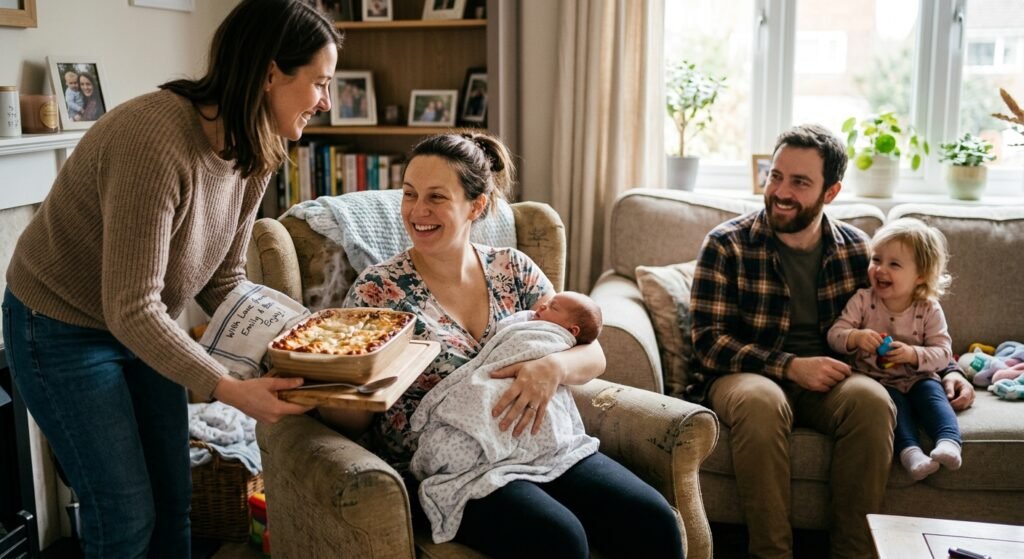
Think of that moment when you walk up to a friend’s porch, carrying a warm casserole dish or a bag of takeout wrapped in foil. You press the doorbell with your elbow because your hands are full. Inside, there’s a quiet, slightly chaotic stillness. When the door opens, you see your friend. She’s holding a tiny newborn, her hair is tied up in a messy knot, and there’s a look of soft exhaustion in her eyes that you’ve never quite seen before.
You don’t stay long because you know she needs space. You hand over the warm container, say a few warm words, and leave. You might think you just saved her from having to cook dinner for one night. But if you could see what happens after the door closes, you’d realize something much larger just took place.
The Quiet Vigilance of New Motherhood
For a new mother, those first few weeks are a blur of constant alertness. Every little sound is magnified. Every minute of the day is organized around someone else’s survival. There is a quiet pressure to keep everything going, to manage the sudden stream of visitors, to keep the house running, and to learn how to care for this brand new life. In the middle of all this, her own basic needs get pushed to the very bottom of the list.
When you ask a new mother how she’s doing, she’ll usually smile and say she’s doing fine, just a little tired. But the truth is she is living in a state of high alert. Her mind is constantly scanning, anticipating, and protecting. It’s a beautiful kind of devotion, but it is also deeply exhausting. She is so focused on giving care that she completely forgets how it feels to receive it.
Why Food Is More Than Nutrition
Let’s look at what food represents emotionally. Since we were small, being fed by someone else has been one of the ultimate signs of safety. When someone cooks for us, they aren’t just giving us nutrients. They are quietly saying, “I see you, and I am going to take care of you so you can rest.”
People who study close relationships often talk about how caregiving isn’t a one-way street. To be able to give care continuously, a person also needs to feel cared for by their community. In those early weeks of parenting, almost all the focus is on the baby. The mother is constantly pouring her energy outward, giving everything to a tiny being who cannot give anything back yet. When a warm meal arrives on her counter, it is one of the very few moments where the care flows back toward her.
It acts as a quiet permission slip. It tells her that she is allowed to stop being the caregiver for a moment and simply be the one who is looked after.
The Hidden Gift of Removing Decisions
There’s a fascinating concept in social support research about the difference between visible support and invisible support. Often, when we ask a struggling friend, “What can I do to help?” we are unintentionally giving them another task. We are asking them to manage us, to think of a chore, to coordinate a time, or to find a way to make us feel useful. It requires mental energy they simply don’t have.
But when you simply show up with a meal that only needs to be heated up, you are providing what researchers call low-effort, high-impact support. You took the decision-making completely out of her hands. You didn’t ask her to host you. You didn’t ask her to make a choice. You just quietly filled a need before she even had to ask, protecting her limited energy when she needed it most.
A Brief Moment of Peace
When she sits down to eat that meal, something changes in the room. For fifteen minutes, she isn’t planning. She isn’t wondering what she has to do next. She isn’t trying to figure out how to feed herself with one hand while holding a crying baby. The constant mental chatter finally goes quiet.
She gets to sit. She gets to taste something she didn’t have to think about, prepare, or clean up afterward. Maybe her partner joins her, or maybe she eats it in the quiet of a dark kitchen while the baby finally sleeps. In those quiet bites, she feels a profound sense of relief. It is the feeling of being held by her community, a soft realization that she isn’t carrying this new chapter entirely on her own.
We often underestimate the power of these tiny gestures. We worry that a simple pasta dish or a container of soup isn’t enough, or that we should be doing something grander. We compare our small offerings to elaborate gifts or expensive nursery gear. But the people who have walked through those early weeks of parenthood will tell you that they don’t remember who bought the plastic toys. They remember the person who brought over the lasagna. They remember the smell of home-cooked food filling a quiet house that had felt a little too lonely that afternoon.
Maybe the meal you brought wasn’t actually about the food at all. Maybe it was the moment she realized she was allowed to stop holding everything together, if only for an hour. Maybe it was the very first time she felt safe enough to rest.