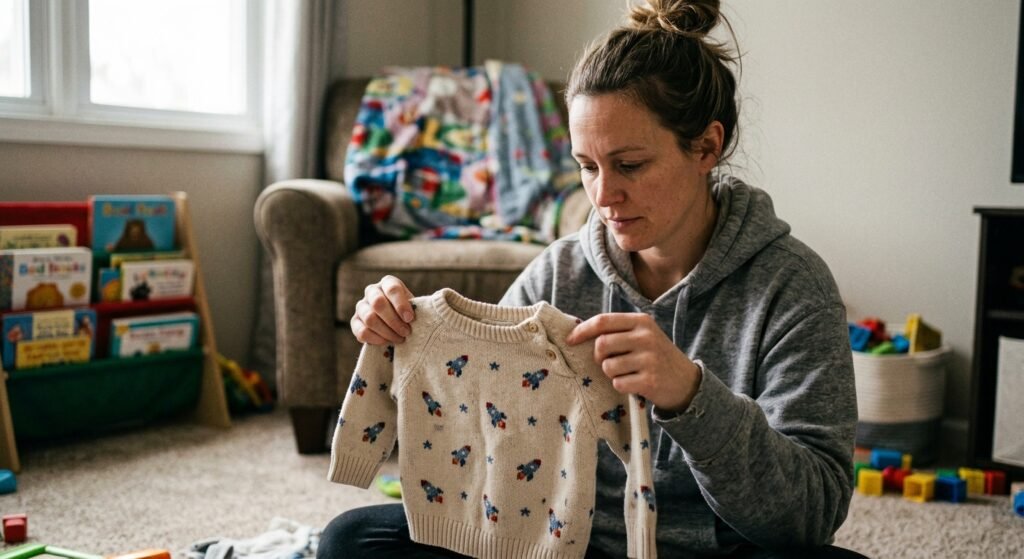
If you’ve ever sat on the floor of a bedroom surrounded by cardboard boxes and packing tape, holding a pair of shoes so tiny they fit entirely in your palm, you already know the quiet ache that comes with packing away a piece of life. You’re supposed to be cleaning out a closet or organizing a playroom. But somehow, holding that small piece of cloth turns a quick afternoon chore into something far more tender.
You fold the outgrown pajamas, press down the cardboard flaps, and suddenly realize that the child who wore them doesn’t exist in that exact way anymore. They’re still here, of course, probably in the other room asking for a snack or running down the hallway. But the tiny person who needed you to snap those buttons every night has quietly slipped away, replaced by someone slightly taller, slightly more independent, and a little further along in their journey.
The Last Time Happens Without Warning
When children are small, days feel long and full of endless repetition. You spend years looking forward to the moment when they can buckle their own seatbelts, tie their own shoes, or pour their own milk without making a mess. You dream about the day when your hands are free again and your schedule belongs a bit more to you.
What nobody tells you is that most milestones don’t arrive with a celebration or a photo. Some of the biggest transitions happen in complete silence. There is a specific day when you pick your child up and carry them on your hip for the very last time, and neither of you knows it’s happening. There is a final afternoon where they ask you to watch them build a wooden train track before that phase quietly ends.
Because those moments don’t give warning, they end up stored in cardboard boxes. Packing up old toys isn’t really about decluttering your house. It’s an unexpected confrontation with time, forcing you to acknowledge how quickly the room changed while you were simply trying to get through the week.
It Was Never Really About the Clothes
It’s easy to feel strange for getting emotional over a box of plastic blocks or a stack of faded t-shirts. You might tell yourself that it’s just stuff, or that keeping items your family no longer needs doesn’t make sense. But specialists who study how people attach meaning to objects know that physical items act as emotional anchors. We don’t hold onto a worn blanket because we love the fabric. We hold onto it because it carries the memory of who we were when we wrapped someone in it.
Psychologists often talk about transition phases in family life as periods where our roles change faster than our hearts can keep up. When you pack away early childhood, you aren’t just storing old belongings. You’re saying goodbye to a version of parenting that defined your daily existence for years.
That early stage demanded your physical presence almost constantly. It was exhausting, overwhelming, and deeply personal. Packing away those items feels like closing a chapter of your own story, even as the larger book continues.
Learning to Let the Chapter Close
There’s a quiet kind of grief that comes with watching someone grow up right in front of you. It’s not a sad grief, exactly, because watching a child grow and flourish is the ultimate goal of taking care of them. It’s a bittersweet feeling, filled with pride for who they’re becoming and a soft nostalgia for who they used to be.
You look at the empty floor space where a crib or a toy chest used to sit, and you realize that your home is quietly keeping score. Each room slowly changes to reflect the growing independence of the people living inside it. The toys get smaller, the books get longer, and the conversations grow deeper.
It’s easy to wonder if you paid enough attention while it was happening. Did you appreciate the storytimes enough? Did you hold them long enough before they squirmed out of your arms to go play? That lingering question is a natural part of caring deeply about someone’s childhood.
Finding Joy in What Comes Next
Maybe the realization isn’t that childhood moves too fast, even though it always feels like it does. Maybe it’s that parenting isn’t about holding onto a single season, but learning how to love each version of your child as they arrive.
When you seal that last box and push it into the attic or hand it to a friend with younger kids, you aren’t erasing those years. You’re simply making room for what’s coming next. The little hand that used to grip your finger while walking across the street will soon hold a backpack strap, wave to you from a bicycle, or reach out to offer you comfort when you need it most.
Every stage brings its own beauty, even if it requires saying goodbye to the one before it. Packing away those early years isn’t an ending. It’s just proof of how deeply you loved being there for them.