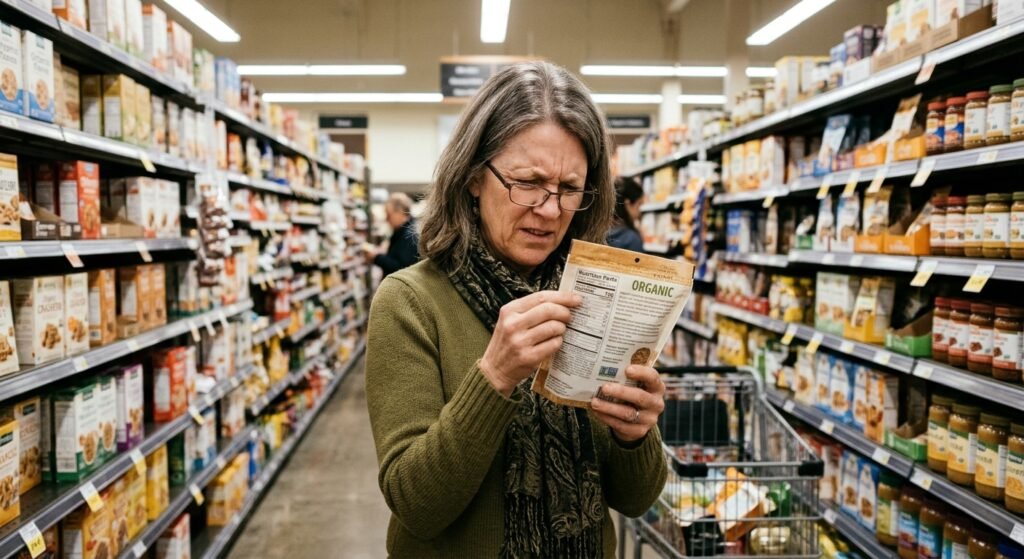
Can we talk about this for a second?
You’re standing in aisle four, holding a bottle of salad dressing, turning it slowly in your hands like you’re inspecting a valuable antique at an auction. You squint at the back panel. You slowly slide your index finger down a block of microscopic text, carefully reading ingredient names that sound less like food and more like synthetic compounds created in a specialized lab. You give a quiet, serious nod, set the bottle back on the shelf, and grab the bottle sitting right next to it so you can perform the exact same inspection all over again.
For some reason this suddenly feels completely reasonable.
You didn’t enter the grocery store today planning to play food investigator. You just walked in to grab a few simple items for dinner. But somewhere between the fresh produce section and the middle aisles, a quiet switch flipped inside your brain. Suddenly, analyzing fine print printed in tiny text feels like the single most urgent task of your entire afternoon.
The Grocery Store Detective
Somehow this always happens. Most of us aren’t trained food chemists. We couldn’t explain what half of those ingredients actually do even if someone offered us a cash prize. Yet there we are, standing under the bright fluorescent store lights, quietly judging a jar of marinara sauce because its third listed ingredient takes three attempts to pronounce out loud.
You convince yourself that you’re making a deeply informed decision. You stand there comparing two almost identical jars of peanut butter. One jar lists four ingredients. The other lists five. You stare at that fifth ingredient like it personally broke a promise to you. You set the five ingredient jar back down with a quiet sense of accomplishment, feeling like you’ve just made a significant, responsible upgrade to your entire week.
At some point it stops being about the food and starts being about the mystery.
We tell ourselves a quiet little story while holding that container in the middle of the store. The story says that as long as we’re reading the label, we’re in complete control of our choices. Grocery stores are large, busy places specifically designed to distract us with bright colors, big signs, and hundreds of options shouting for attention. Stopping to read the back panel gives us a moment to slow down. It makes us feel like thoughtful researchers taking our time, rather than shoppers who just grabbed whatever was sitting at eye level because the box looked pretty.
The Moment Curiosity Turns Into Confusion
The funny thing is that reading the label rarely gives us the clarity we think it will. In fact, it usually creates more questions than answers.
You find yourself staring at words like guar gum, sodium acid pyrophosphate, or natural flavors. What does natural mean in this context? Does it mean it came from a tree, or does it mean someone in a lab coat smiled while mixing it? You don’t actually check to find out. You just hold the box closer to your face, as if bringing the text two inches nearer to your eyes will magically unlock its secrets.
Then you notice the serving size.
That tiny box of crackers claims one serving is exactly four and a half crackers. Who eats four and a half crackers? How do you even leave half a cracker behind in the sleeve? But instead of laughing at how ridiculous that sounds, you nod along as if that math makes complete sense. You do a quick mental calculation, pretend you’re only going to eat the suggested four crackers, and gently place the box into your cart.
The Double Standard in Your Cart
The funniest part of this whole habit isn’t the intense inspecting. It’s the total inconsistency that comes immediately after it.
Five minutes later, you stroll over to the bakery department or the frozen food section. You spot a box of chocolate chip cookies or a bag of frozen pizza snacks. Do you flip that box around? Do you squint at the fine print on the back? Do you wonder why the chocolate chips look so shiny?
Not even for a single second.
You toss it straight into your cart without a moment of hesitation. The back of the package suddenly doesn’t exist anymore. You’ve somehow decided that official research rules only apply to things like oat milk, canned beans, and salad dressing. Dessert operates in a completely separate universe where ingredients don’t count and curiosity isn’t required.
We all know how this ends, too. You bring those carefully chosen items home, unload the bags, and put them away in the pantry. Two days later, you’re making lunch. You pull out the jar you spent three full minutes analyzing in the store aisle. You open the lid, pour it out, and realize you haven’t thought about that fifth mystery ingredient since the moment you paid for it.
A Small Illusion of Control
Why do we keep doing this? It turns out our brains just really like feeling responsible in small, manageable doses. We can’t control every confusing detail of our daily lives, but for thirty seconds in aisle four, we can definitely choose the pasta sauce with the shorter ingredient list. It gives us a tiny hit of satisfaction, even if we turn around and buy a box of frosted donuts five steps later.
It is a harmless little routine that makes the ordinary task of buying food feel a bit more deliberate. We pretend we’re solving a high stakes puzzle when we’re really just deciding between two nearly identical brands of crackers.
So the next time you find yourself standing frozen in the middle of an aisle, holding a container upside down while trying to figure out what xanthan gum actually is, don’t worry about it. You aren’t alone. Everyone around you is doing the exact same thing with their own canned goods.
You’ll probably stand there for another minute, put it back, grab the other option, and feel great about your choice all the way to the register. And honestly… you’ll probably do it all over again next week.