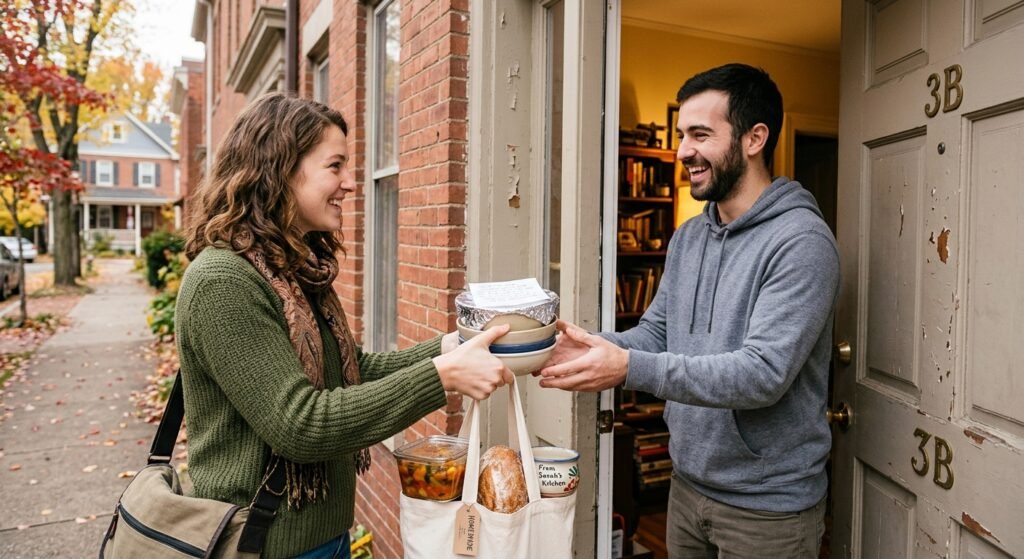
You’ve likely stood on both sides of this exchange. You’re either the person standing on a porch in the fading evening light, holding a glass baking dish wrapped in a clean kitchen towel, or you’re the one opening the door in your sweatpants, feeling a mixture of profound gratitude and soft embarrassment. There’s no grand speech. There are no dramatic declarations of support. Instead, there’s just the quiet click of a plastic lid and a soft assurance that the dish doesn’t need to be washed before it is returned.
There’s a specific kind of quiet that settles over a home when life gets too complicated to manage. The mail piles up by the door, the sink fills with dishes that feel too loaded to wash, and the simple question of what to eat for dinner begins to feel like an insurmountable obstacle. In those moments, the kitchen stops being a place of nourishment and becomes a physical chore. Standing over a stove, chopping vegetables, and waiting for water to boil require an emotional currency that you simply don’t have to spend.
When the Kitchen Becomes Too Loud
We don’t often talk about how much energy it takes to feed ourselves. In ordinary times, the rhythm of meal preparation is so natural that we don’t even notice the sequence of choices it requires. You have to decide what you want, ensure you have the ingredients, manage the timing, and then face the clean-up afterward. It’s a multi-step process that demands focus and agency.
But when you’re navigating a difficult season, whether it’s the exhaustion of a demanding job, the fog of a personal transition, or the dense quiet of grief, that process breaks down. Your mind is already working overtime just to process the reality of your day. Under that kind of pressure, looking into a refrigerator filled with raw ingredients can make you feel entirely defeated. It’s not that you’re not hungry, it’s that the path between your hunger and a finished meal feels far too long to walk.
This is where the unique beauty of a delivered meal comes in. When a friend brings you a container of soup or a warm tray of pasta, they’re not just providing calories. They’re quietly removing the burden of decision-making from your evening. They’re giving you permission to simply sit down and receive, without requiring you to plan, prepare, or perform.
The Psychology of Practical Comfort
Sociologists and researchers who study how communities support one another often distinguish between different types of care. They speak of emotional support, which involves listening and validating feelings, and practical support, which involves tangible help with daily tasks. While emotional support is vital, studies consistently show that during times of acute stress, practical support often brings the most immediate sense of relief. It acts as a buffer against the world, protecting your limited energy when you need it most.
When someone cooks for you, they’re engaging in a form of practical care that is deeply restorative. It’s an act that bypasses the intellect and speaks directly to our need for safety. From our earliest days, being fed by someone else is our first experience of being kept safe. That ancient connection doesn’t disappear just because we grow up. When a friend places a warm meal in your hands, your nervous system registers the gesture on a level that words cannot reach.
It’s a way of saying that your physical existence matters, even when you don’t have the strength to tend to it yourself. The soup in the jar is proof that someone thought about your evening before you even had to face it.
The Language of Mismatched Containers
There’s an unspoken etiquette to this kind of cooking. We rarely make elaborate, experimental dishes for someone who is struggling. We don’t try out complicated recipes or worry about perfect presentation. Instead, we reach for the things that feel safe and reliable. We make lasagnas, potato soups, roasted vegetables, and simple casseroles.
We cook the kinds of food that can sit in the refrigerator for a few days and taste even better when they’re reheated. In doing so, we’re quietly planning for the other person’s tomorrow. We’re acknowledging that their exhaustion will likely still be there when they wake up, so we make sure there’s enough for another round. The food is sturdy, forgiving, and patient, which is exactly what the person eating it needs to be allowed to be.
And there’s something beautiful about the containers themselves. They’re rarely fancy. They’re the mismatched plastic tubs with slightly warped lids, or the disposable aluminum pans that don’t need to be returned. They’re practical, unpretentious, and entirely focused on utility. They don’t demand anything from the recipient, not even the obligation of washing a dish.
A Quiet Form of Belonging
Perhaps the deepest realization that comes from these moments is that care doesn’t have to be perfect to be profound. We often hold back from helping because we worry we’ll say the wrong thing, or because we think our small contributions won’t make a difference. We wait for the perfect moment or the perfect gesture, and in doing so, we sometimes miss the opportunity to show up at all.
But a friend who is going through a hard time doesn’t need an extraordinary gesture. They don’t need a gourmet meal or a masterfully crafted speech. They simply need to know they aren’t navigating the silence alone. A warm container of food on the counter is a quiet testament to that truth.
It suggests that maybe we don’t have to carry everything by ourselves, even when we think we do. Sometimes, letting someone else cook for you is its own form of courage. It is an admission that you are temporarily out of resources, and that it’s okay to let the people who love you step in and fill the gap. In the end, the meal is never just about the food. It’s about the comfort of knowing that when your own kitchen goes dark, someone else will keep their light on for you.