
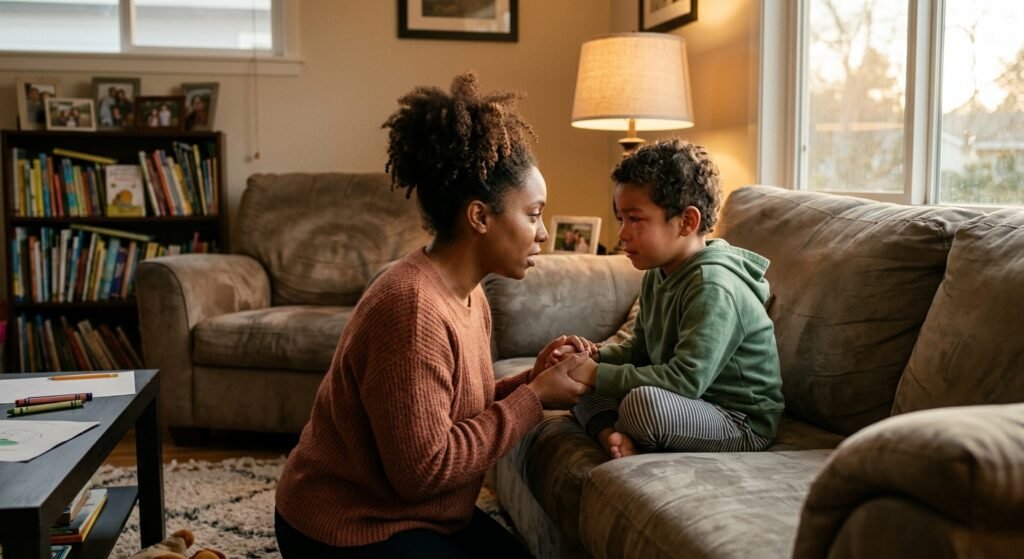
You’re standing in the kitchen when you hear the sudden crash from the living room. It’s followed immediately by a sharp cry, the sound of a toy being thrown, and then an abrupt silence. When you walk in, you see one child rubbing a sore arm and another standing in the corner, arms crossed, glaring at the floor. Your first instinct is entirely protective. You want to comfort the one who was hurt and reprimand the one who did the hurting. It’s a natural reaction, born out of a desire for peace and fairness in your home.
But when you look closer at the child in the corner, you don’t see a victor. You see a small person whose shoulders are hunched up to their ears, whose breathing is shallow, and whose eyes are darting around the room like they’re waiting for a storm to break. Beneath the anger, there is a distinct flicker of fear. It’s in these moments that we’re forced to confront one of the most challenging realities of living with and loving children: the ones who need our gentlest care are often the ones whose actions make them the hardest to embrace.
This scene plays out every day in classrooms, on playgrounds, and at family dinner tables. The child who knocks over a classmate’s carefully built tower, the teenager who says the sharpest, most painful thing to their parent, or the student who constantly disrupts the group. Our first instinct is to focus entirely on the behavior because the behavior is loud and disruptive. We want to stop it, correct it, and ensure it doesn’t happen again. But if we only look at the disruption, we miss the story behind it.
The Story Behind the Disruption
For decades, people who study development and emotional health have pointed to a fundamental truth: young people don’t have the sophisticated tools required to process deep emotional pain. When a child feels rejected, unseen, unsafe, or overwhelmed, they don’t sit down and explain their feelings over a cup of tea. They don’t have the vocabulary to say they feel left out or that they’re worried they aren’t good enough. Instead, they show us. Their internal distress becomes external behavior.
This isn’t an excuse for hurting others, but it is an explanation. To a developing mind, acting out is often a desperate attempt to feel some sense of control when everything else feels unstable. When a child’s internal world is chaotic, creating a little external chaos can feel strangely comforting because it matches what they feel inside. It’s a protective shield, even if it looks like a weapon to the people around them.
Research into how young minds process stress shows us that when a child’s nervous system is overwhelmed, the brain’s priority moves away from logical thinking and empathy. Instead, it enters a state of survival. In this state, a child cannot easily access the parts of their brain that understand consequences or control impulses. They are simply reacting to a threat that feels very real to them, even if that threat is just a feeling of not belonging.
The Dilemma of Discipline
This understanding places caregivers in a challenging position. Knowing that a child is hurting doesn’t make their behavior acceptable. We still have to step in. We have to protect others, and we have to teach children that their actions have real consequences. If we ignore the bad behavior, we fail to teach them how to live in a world that expects accountability.
But there’s a vital difference between holding a child accountable and making them feel cast aside. Too often, we treat accountability and compassion as if they are locked in a struggle against each other. We worry that if we show too much understanding, we are letting them off the hook. We worry that if we don’t punish them strictly, they’ll never learn. We assume that to be firm, we must also be cold.
But maybe we don’t have to choose between protecting the world from a child’s behavior and protecting the child from their own pain. Compassion and accountability aren’t opposites; they are two sides of the same fence that keeps a child safe. When we set clear boundaries while remaining emotionally close, we show them that their behavior is unacceptable but they themselves are still deeply valued.
A Different Way of Seeing
When we start to look past the outward behavior and focus on the distress underneath, our response changes. Instead of asking a defensive child why they did something, we start asking ourselves what they might be trying to communicate. We begin to see the child who lashes out not as a troublemaker, but as someone who is struggling to stay afloat.
This perspective doesn’t make the hard days easy, but it does make them meaningful. It helps us realize that the path to better behavior isn’t through isolation or shame, but through connection. A child who is drowning in big emotions can’t learn how to swim until we help them feel safe enough to breathe.
If you’ve ever felt exhausted by a child’s defiance, or if you’ve ever looked back at your own younger years and realized how much of your own sharp behavior came from a place of unhealed hurt, you’re not the only one. We’re all trying to navigate these complicated moments. And perhaps the greatest gift we can give the children in our lives isn’t a perfect lesson, but the reassurance that even in their most difficult moments, we will still be there, helping them find their way back.