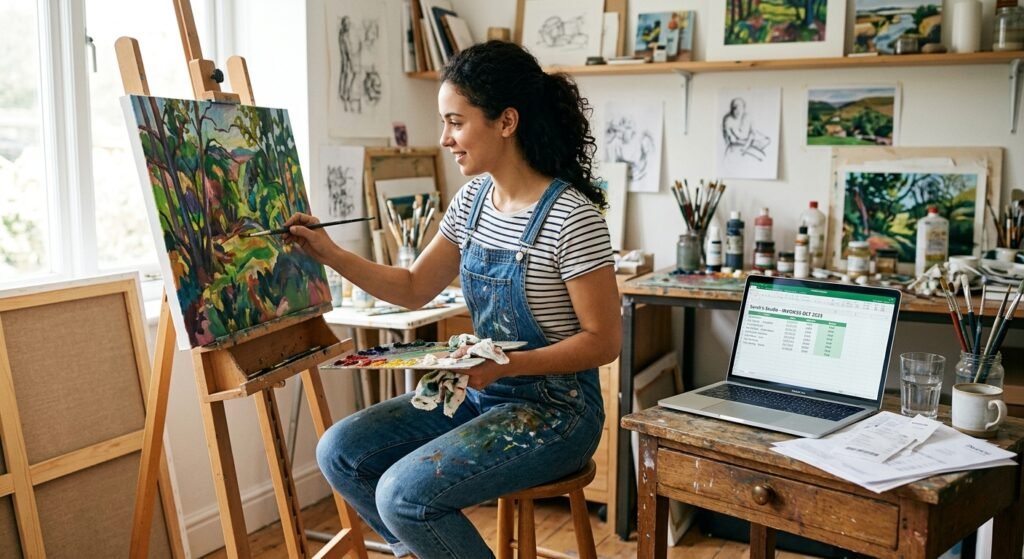
Imagine sitting at your kitchen table on a quiet Sunday afternoon, surrounded by a mess of colorful yarn, watercolor paints, or perhaps the floury remains of a freshly baked loaf of bread. You’ve spent the last two hours completely lost in the simple act of making something with your hands. Your phone is face down, your shoulders have dropped, and for the first time all week, your mind is quiet. It’s a rare, beautiful pocket of peace. Then, you show a picture of your creation to a friend, or maybe your partner walks in, takes a look at your work, and says those fateful words: you could totally sell these on Etsy.
It’s meant as a compliment, of course. It’s a validation of your skill and a vote of confidence in your taste. But inside you, something subtle begins to change. The quiet, spacious feeling of playfulness starts to shrink, and in its place, a tiny, industrious voice begins to whisper. What if I did sell them? How much do shipping boxes cost? What would I name the social media account? Suddenly, your peaceful afternoon escape is drafted into service as a potential business plan.
The Subtle Pressure to Optimize Our Joy
This transition from hobbyist to entrepreneur doesn’t usually happen with a grand master plan. It happens in tiny, almost imperceptible steps. You start knitting scarves because you love the feel of the wool, but soon you’re keeping track of how many hours each scarf takes. You start gardening because you love the soil, but eventually you’re wondering if you should package your heirloom seeds to sell at the local market. What started as an act of pure recreation quietly transforms into a second job, complete with its own production schedules, quality control, and inventory worries.
We’ve become remarkably skilled at turning our play into work. It’s almost as if we don’t know how to exist in a space of pure leisure anymore without feeling a nagging sense of guilt. If we aren’t producing something tangible, marketable, or useful, we worry that we’re simply wasting time. We’ve internalized the idea that our personal hours are a crop that must always be harvested, and any hour left fallow is a failure of efficiency.
Why We Struggle to Let Ourselves Just Play
There’s a curious pattern in how we relate to our free time. When we look at children playing with blocks or coloring outside the lines, we don’t ask them how they plan to scale their building projects or if they’ve considered building a portfolio of their artwork. We recognize that the value is entirely in the doing. The child is exploring, learning, and simply being. Yet, as we grow older, we lose our permission to do things poorly, slowly, or just for the sheer fun of it.
Some psychologists suggest that our obsession with turning hobbies into businesses is a way to cope with modern anxiety. In a world where our daily work can feel abstract or disconnected, creating a physical object offers a deep sense of control and accomplishment. But when we immediately attach a price tag or an audience to that creation, we change the chemical makeup of our motivation. We take something that was driven by curiosity and tether it to external validation. The moment a hobby becomes a hustle, the joy of the process is replaced by the anxiety of the outcome.
The Difference Between Loving a Craft and Running a Business
It’s easy to confuse the love of an activity with the desire to do it for a living. Loving to bake cookies is a beautiful thing. Managing inventory, sourcing bulk ingredients, navigating safety regulations, replying to customer complaints, and running social media ads is a completely different skill set. When we monetize our passions, we often find that the actual craft we loved becomes only ten percent of the experience, while the remaining ninety percent is filled with the administrative tasks we were trying to escape in the first place.
We forget that some things are precious precisely because they don’t have to support us. When a creative outlet doesn’t have to pay your rent, it’s allowed to be messy. It’s allowed to fail. You can paint a terrible picture, laugh at it, and throw it in the trash without feeling like you’ve wasted valuable resources. That freedom to make mistakes is where true creativity lives. When you force your creativity to earn its keep, you quietly strip away its ability to surprise you.
Reclaiming the Art of Doing Nothing Useful
Perhaps the real challenge isn’t that we have too many good ideas, but that we’ve forgotten how to defend our boundaries against the pressure of productivity. We live in a culture that treats rest as something you must earn, and leisure as a luxury you should optimize. But what if we decided that some parts of our lives are simply not for sale? What if we kept our small, messy, imperfect creations entirely to ourselves?
There’s a quiet rebellion in dedicating three hours to learning a difficult piano piece you have no intention of ever playing for an audience. There’s a profound sense of peace in spending a Saturday afternoon painting a landscape that will never leave your sketchpad. These aren’t wasted hours. They’re the moments where we replenish ourselves, where we step off the treadmill of performance and simply exist.
Maybe the next time you finish making something and that little voice suggests you could sell it, you can take a deep breath and offer yourself a different path. You can look at your creation, appreciate the time you spent making it, and decide that its only job was to bring you a few hours of quiet. Some things are too valuable to be priced. And maybe, just maybe, the most productive thing you can do with your favorite hobby is to let it remain completely useless to everyone but you.