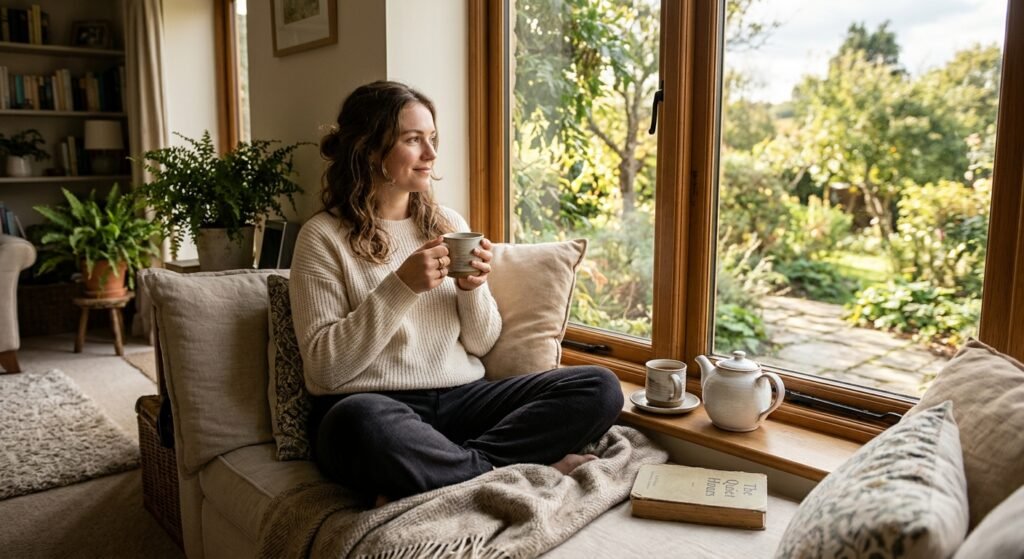
If you’ve spent months or years wishing for life to settle down, you know the relief you’re supposed to feel when things finally get quiet. The high-stress work project comes to an end. The family drama cools off. The relationship feels stable and predictable. You finally have the exact peace you kept promising yourself you wanted.
Then a strange thing happens. You sit on your couch on an ordinary Tuesday evening, waiting for a deep wave of satisfaction to wash over you. Instead, you feel twitchy. You pick up your phone, unlock it, look at a blank screen, and put it back down. You check your inbox for an urgent message that isn’t there. You feel an odd, lingering restlessness that feels surprisingly close to boredom.
It’s an unsettling sensation because it makes you question yourself. You wonder why you can’t just enjoy the quiet moments you fought so hard to reach. You wonder if you’re ungrateful, or if something is secretly missing from your life. But the truth is usually much simpler and far more gentle than that.
When Chaos Was Your Baseline
When you’ve lived through a long season of unpredictable stress, your mind adapts to constant momentum. You get used to keeping your guards up, responding to sudden changes, and solving one problem right before the next one appears. Staying alert becomes your natural state of being.
In those seasons, high intensity becomes your benchmark for reality. A packed schedule feels productive, an urgent phone call feels important, and high stakes make you feel awake. Your mind becomes conditioned to associate constant motion with purpose.
So when the chaos finally stops, your internal system doesn’t instantly celebrate. It doesn’t look around a quiet room and automatically feel relaxed. Instead, it looks around and wonders where the emergency went. The sudden absence of urgency feels less like comfort and more like an uncomfortable void waiting to be filled.
Mistaking Peace for a Lack of Passion
This transition can be particularly confusing in our personal lives. If you’ve spent years in dynamics where love was marked by emotional highs and low valleys, a healthy, peaceful connection can feel surprisingly quiet at first.
There are no late-night misunderstandings to solve, no mixed signals to decode, and no frantic efforts to repair a sudden breach. There’s just consistency, quiet kindness, and reliable presence. To a heart that has learned to measure devotion by how hard it has to fight for reassurance, that stability can feel almost dull.
You might catch yourself wondering if the spark is missing, or if you’re slowly losing interest in someone who treats you well. Psychological research into emotional adaptation helps explain why this happens. When our brains are used to high levels of emotional arousal, we often confuse the calm absence of anxiety with a loss of affection.
We mistake peace for indifference simply because we’ve never learned how to feel connected without feeling anxious at the same time. The relationship isn’t missing excitement; it’s providing the safe ground you never had space to experience before.
The Energy of Unused Protection
Living in a constant state of readiness requires an immense amount of focus. You learn to pay close attention to tone of voice, subtle changes in mood, and subtle signals that something might go wrong. You build an impressive capacity for managing tension.
When you move into a safe season of life, that protective focus doesn’t just disappear. It lingers, looking for something to do. Without a real problem to solve, your mind might start searching for small things to fix, micro-analyzing casual comments, or worrying about imaginary future setbacks.
That unused protective energy is what we often mislabel as boredom. It’s the fidgety, restless feeling of a mind trained for survival trying to navigate an ordinary afternoon where nothing is demanding to be fixed.
It takes time to convince yourself that peace isn’t a trap. When you’re used to waiting for the other shoe to drop, a long stretch of calm can feel like a setup. Learning to trust the stillness is often harder than enduring the chaotic moments that came before it.
Learning a New Emotional Language
Feeling bored during a season of calm isn’t a flaw in your personality, nor is it a sign that you’ve made a mistake. It’s simply the awkward middle phase of adjusting to a life that no longer requires you to be on high alert.
Peace requires a completely different emotional language than survival does. Survival demands speed, hyper-vigilance, and intensity. Peace asks for patience, presence, and a willingness to sit with simplicity without needing to turn it into a project.
When you stop needing to defend yourself or constantly manage the world around you, you’re left with a wide open space. That space can feel intimidating at first because it asks you to get comfortable with quietness. But inside that quietness is where genuine rest actually lives.
Maybe calm was never meant to feel like a grand celebration or an endless surge of inspiration. Maybe peace is simply the quiet realization that nothing is currently burning down, and for the first time in a long while, you don’t have to do anything except exist right where you are.