
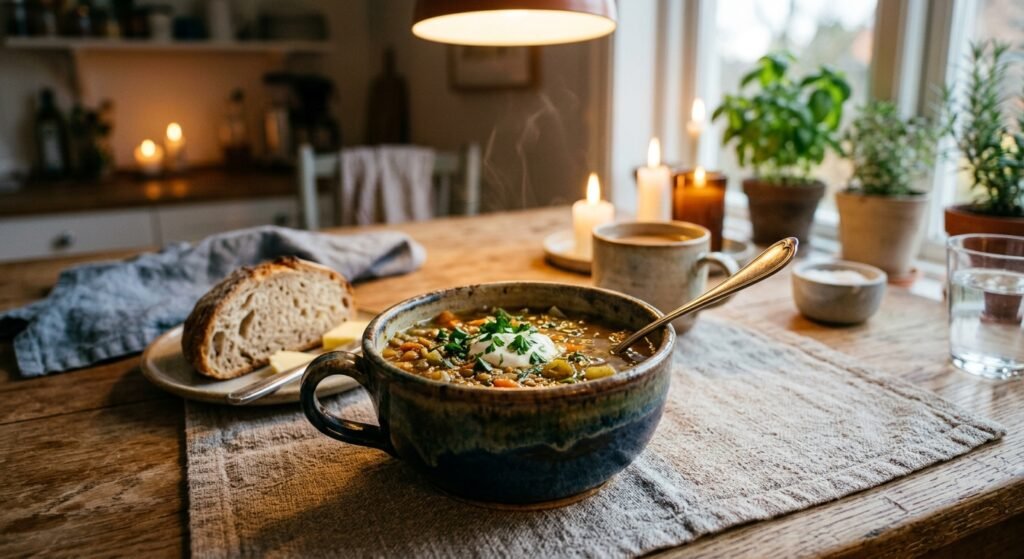
Think about the last time you felt exhausted, a little raw, or just completely done with the day. Maybe you decided to make a quick bowl of soup, some pasta, or even just some warm oatmeal. When you opened the cabinet, you probably bypassed the perfectly fine, expensive dinner plates and reached for one specific bowl. It might have a chipped rim, a slightly faded pattern from years of dishwashers, or a shape that fits perfectly into the palm of your hand. If that specific bowl isn’t clean, you might even find yourself washing it by hand rather than choosing a different one from the stack.
It seems silly when you think about it. The food tastes exactly the same regardless of what it’s served in. Yet, we’ve all felt that quiet wave of disappointment when our favorite bowl is dirty or packed away in a box. We realize that the meal doesn’t feel quite as restorative when it’s eaten from a cold, oversized ceramic dish that belongs to a matching set. This isn’t just a quirk of habit. It’s a quiet testament to how we seek safety in the smallest details of our daily routines.
The Architecture of Comfort
There’s a subtle science to why we develop these attachments to our everyday objects. Psychologists often point to what is known as the endowment effect, where we ascribe more value to things simply because they are ours and have been part of our lives. But with comfort food, the connection goes deeper than mere ownership. When we hold a warm bowl in our hands, we’re engaging in a sensory experience that grounds us in the present moment.
Think about the physical act of eating from a bowl compared to a flat plate. A plate keeps food at a distance, requiring a fork and knife, a certain posture, and an air of formality. A bowl, however, invites you to cradle it. It demands to be held. The warmth of the food transfers directly to your hands, sending a physical signal to your nervous system that you are safe, warm, and taken care of. It’s a tactile language that bypasses our analytical minds entirely.
When you’re eating from that specific dish, you aren’t just consuming calories. You’re participating in a ritual of caring for yourself. The texture of the ceramic, the depth of the bowl, and even the way your spoon scrapes against the bottom all contribute to a sense of predictability. In a world that often feels chaotic and unpredictable, having one small corner of your day go exactly as expected is remarkably soothing.
The Nostalgia Coded Into Ceramic
Often, these vessels are quiet repositories of our personal histories. You might have received that bowl as a housewarming gift when you first moved into your own apartment, or maybe you kept it after a college roommate moved out. Perhaps it simply looks like the ones your parents kept in the cupboard when you were young. Every time you use it, you’re tapping into a reservoir of past comfort, connecting your current self with a younger version who also needed to feel safe and fed.
Researchers studying the psychology of nostalgia have found that objects associated with positive memories can actually act as emotional anchors. When we interact with them, they trigger a chemical response in the brain, releasing dopamine and oxytocin, which help reduce stress. The bowl becomes a physical bridge to times when we felt secure, loved, or simply at ease. It’s a form of emotional shorthand, allowing us to access a state of peace without having to work hard to find it.
That’s why a mismatch in our dinnerware can feel so deeply unsettling during a hard week. If you’ve had a day where everything went wrong, you don’t want novelty. You don’t want the sleek, modern design of a new dish. You want the bowl that knows you. You want the one that has seen you through previous cold winters, difficult breakups, stressful jobs, and quiet Sunday mornings. You want the consistency of something that hasn’t changed while everything else around you has.
The Ritual Is More Than The Recipe
We live in a culture that often focuses on the grand gestures of happiness. We’re told that to find peace, we need to take elaborate vacations, completely overhaul our lifestyles, or achieve massive personal goals. But if you pay attention to the moments that actually make you sigh with relief, they’re almost always small, private, and entirely unglamorous. They’re found in the steam rising from a familiar mug, the quiet of the house before everyone else wakes up, or the simple comfort of eating a familiar meal from a favorite dish.
Maybe the bowl was never really about the food at all. Maybe the bowl is a boundary. When we sit down with it, we’re signaling to ourselves that the productive part of the day is over and that we are allowed to rest. It’s a physical marker of a transition from doing to simply being. By choosing that specific object, we are creating a small sanctuary for ourselves, one spoon at a time.
The next time you find yourself washing your favorite bowl by hand while the rest of the cabinets are full, you don’t need to laugh at your own stubbornness. Instead, you can appreciate the quiet wisdom of your own habits. We don’t just need food to survive; we need to feel held. And sometimes, the easiest way to hold ourselves is to start with a warm bowl that fits perfectly in our hands, reminding us that no matter how chaotic the world gets, comfort is still something we can hold onto.