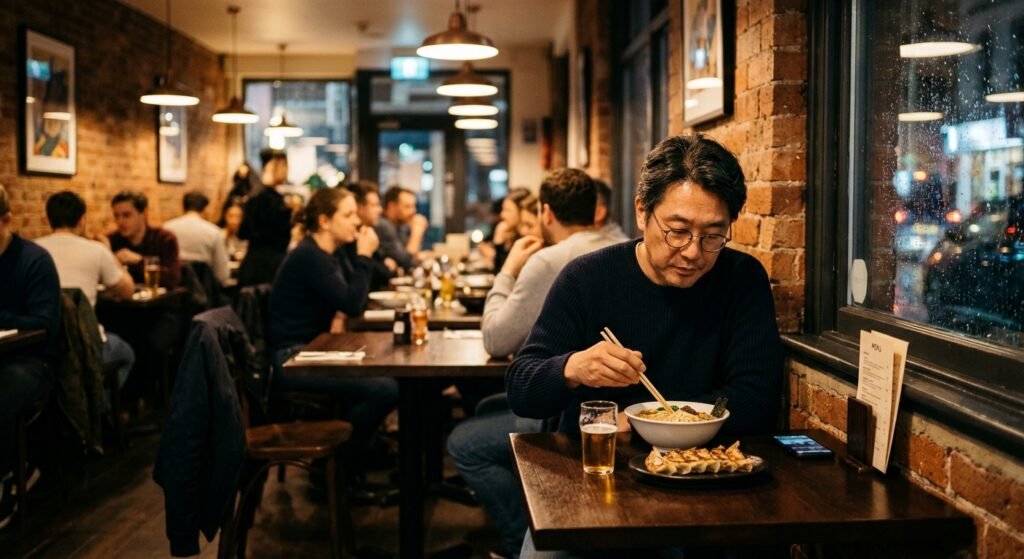
If you’ve ever walked into a restaurant alone, you know that brief, hesitation-filled moment right at the host stand. The host looks past your shoulder, pauses for a second, and asks if anyone will be joining you. You say it’s just you, and for a split second, a tiny flicker of self-consciousness whispers that maybe you should have ordered takeaway instead.
Then you get led to a table, usually tucked away near a corner or beside a window. You sit down, pull out the chair, and immediately feel the urge to grab your phone. It’s an instinctive defense mechanism, a way to signal to the rest of the room that you’re busy, connected, and definitely not lonely.
But then something lovely happens if you decide to keep your phone in your pocket.
The initial awkwardness starts to dissolve, replaced by a quiet stillness you rarely give yourself permission to feel. You look around the room. You watch the warm steam rising off a pasta bowl at the next table, listen to the gentle clinking of silverware, and notice how the candlelight bounces off the glassware. Suddenly, eating alone doesn’t feel like something to survive. It feels like a small, quiet victory.
Moving From Being Seen to Simply Seeing
Most of our meals are active social events. We’re busy catching up with friends, navigating family conversations, or coordinating work schedules over lunch. In those moments, the food is often secondary, acting as background scenery while we focus on keeping the conversation going.
When you sit down to eat by yourself, that dynamic flips completely. Without the pressure to perform or respond, your attention expands outward. Researchers who study environmental awareness note that when people step away from social evaluation, their sensory focus naturally heightens. You start tasting things more clearly. The bread is warmer than usual, the olive oil richer, the soup cooked with an extra layer of care you would have completely missed if you were mid-story.
You aren’t just eating food anymore. You’re actually experiencing it, noticing how much thought someone in a kitchen behind swinging doors put into combining flavors just right for whoever happened to order it.
Love Is Found in the Details We Usually Rush Past
There’s a subtle kind of affection built into the hospitality world that we rarely slow down to appreciate. It’s in the way a server thoughtfully refills your water glass without interrupting your thoughts, or how a cook garnishes a dish with fresh herbs right before it leaves the pass.
When you’re dining alone, you become a quiet witness to these ordinary acts of care. You notice the couple two booths over laughing at an inside joke, or the way the busser wipes down a wooden table with deliberate, practiced care. It reminds you that warmth isn’t always something expressed through big, dramatic declarations. More often than not, affection lives in the quiet, tiny gestures people make every day to care for strangers and each other.
Taking yourself out to dinner allows you to receive those small gestures fully. You aren’t rushing toward the end of the evening or checking off a chore on a list. You’re simply letting someone else cook for you, serve you, and give you a cozy space to exist for an hour.
Learning to Enjoy Your Own Company
We live in a culture that constantly encourages us to stay connected, stay busy, and keep moving. Because of that, spending unscheduled time alone in public can almost feel rebellious.
Yet, when you sit through that initial wave of self-consciousness, you discover a deeply comforting truth. Nobody in the dining room is judging you or wondering why you’re by yourself. Everyone is simply wrapped up in their own lives, their own conversations, and their own meals. The freedom that comes with that realization is immense. You don’t have to entertain anyone, agree with anyone, or adjust your pace to match someone else.
You get to eat at your own speed, think your own thoughts, and enjoy the simple pleasure of a good meal prepared with effort. It becomes a quiet moment of taking care of yourself, disguised as an ordinary Tuesday night dinner.
A Quiet Realization at the Table
By the time the bill arrives and you take that last sip of water, the world outside feels just a little bit gentler. You walk out the door feeling restored rather than isolated.
Maybe eating alone at a restaurant isn’t about proving your independence or showing that you don’t need company. Maybe it’s about realizing that you were never really disconnected from the world to begin with. Tiny details carry enormous affection, both from the hands that prepared your meal and from the quiet decision to pull up a chair and pay attention to your own life.