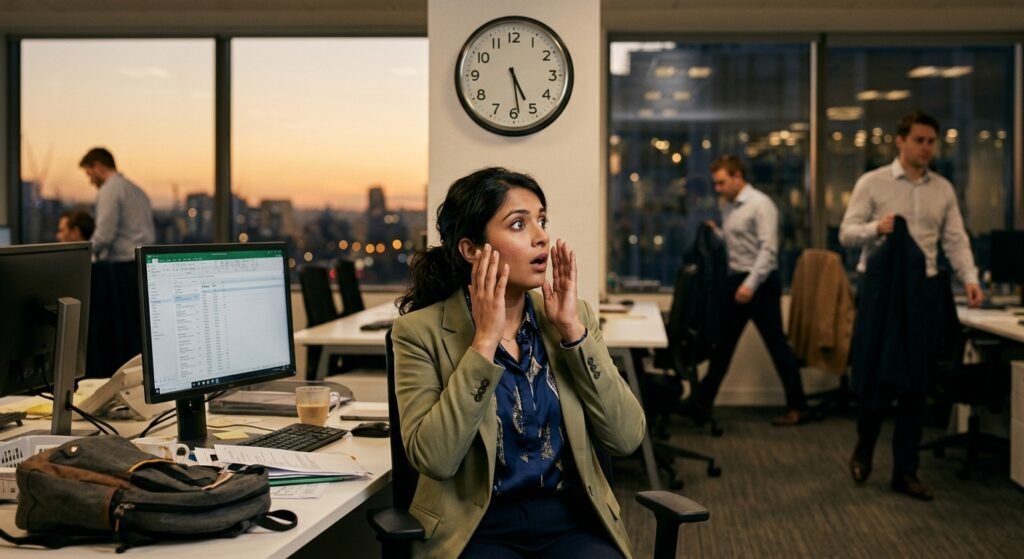
The Great Clock Watching Negotiation
Can we talk about this for a second?
You’re sitting at your desk, and you make the mistake of looking at the little clock in the bottom right corner of your computer screen. It says 2:15 PM. You decide right then and there that you’re going to put your head down and really focus. You answer four emails that you’ve been avoiding, you clean up your digital desktop, you file three folders, and you even write a quick summary for a project. You feel a deep, satisfying sense of accomplishment. You’ve been working so hard that you feel like a completely new, wonderfully productive person. Surely, it must be at least 3:30 PM by now. You take a deep breath, smile, and look back at the clock.
It’s 2:18 PM.
The sudden wave of disbelief that washes over you in that moment is a very specific feeling. For a second, you genuinely wonder if the digital clock on your computer has run out of batteries, even though you know that isn’t how computers work. You consider restarting your system just to see if the time updates. But deep down, you know the truth. The clock isn’t broken. Time has simply decided to move at its own pace, completely ignoring the sheer amount of effort you just poured into your keyboard.
The Art of the Silent Bargain
This is when we start playing little mental games to survive the rest of the afternoon. We create rules that we immediately break. The most common one is the no look pact. You tell yourself, “Okay, I’m not going to look at the clock again until I finish this entire task.” You convince yourself that if you can just ignore the time, the minutes will slip by unnoticed, like a friend trying to sneak out of a party. For some reason, this suddenly feels completely reasonable in the moment.
But five minutes later, the temptation becomes too strong. You don’t want to look directly at the clock, because that would mean admitting defeat. Looking directly at it feels too deliberate. So you try to look past it. You pretend you’re focusing on a document in the middle of the screen, but you let your eyes wander slightly to the right, hoping to catch the numbers in your peripheral vision. You’re trying to surprise the clock, as if looking at it quickly will catch it off guard before it has a chance to freeze. We all know how this ends. You look, you see that only four minutes have passed, and you’re forced to start the negotiation process all over again.
Why Some Days Move Differently
Then, there are those other days. You arrive at your desk, you start working on a few simple things, and suddenly you look up and realize it’s already time to go home. You didn’t even have time to play the clock watching game. You didn’t have to bargain with yourself. The hours just melted away, and you leave the office feeling satisfied and successful. Somehow, this always happens on the days when we aren’t trying to force the day to end. At some point, it stops being about how much you’re actually getting done and becomes about how deeply you’re engaged with the task at hand.
Our experience of time is rarely about math. It’s almost entirely about where our attention is pointing. When we’re looking forward to the end of the day, we are actively measuring the distance between where we are and where we want to be. Every time we check the clock, we’re asking, “Are we there yet?” And just like a long car ride, asking the question only makes the journey feel twice as long. But when we’re focused on the task itself, we forget to measure the distance. We’re just traveling. The funny thing is, we know this, yet we still can’t help but look.
Often, the days that move the fastest aren’t the ones where we’re saving the day or doing highly creative work. They’re the days filled with small, repetitive, low stakes tasks. Sorting through old files, organizing your inbox, or updating a simple spreadsheet can feel strangely comforting. There’s no pressure, which means there’s no anxiety, which means we aren’t constantly checking our progress. We just slip into a quiet rhythm. Before we know it, three hours have passed, and we’ve managed to completely lose track of time while doing something that doesn’t feel like a chore.
Finding Your Own Rhythm
Nobody talks about how common this is. We all sit in the same offices, staring at our respective screens, playing the exact same quiet games with the clocks in our corners. We look at each other during afternoon meetings, sharing a silent look of mutual understanding that says, “I can’t believe we still have two hours left.” It’s a comforting thought, really. We’re all trying to navigate the strange, elastic nature of a standard workday together.
So the next time you find yourself staring at 2:18 PM with a sense of quiet frustration, don’t worry. You haven’t entered a frozen moment in time. You’re just paying too much attention. Try to find a simple, boring task to lose yourself in, or maybe just close your eyes for a second and accept that today is going to be one of those longer days. We’ve all been there, and honestly, you’ll probably do it again tomorrow. But for now, just try to ignore the bottom right corner of your screen. It’s doing the best it can.