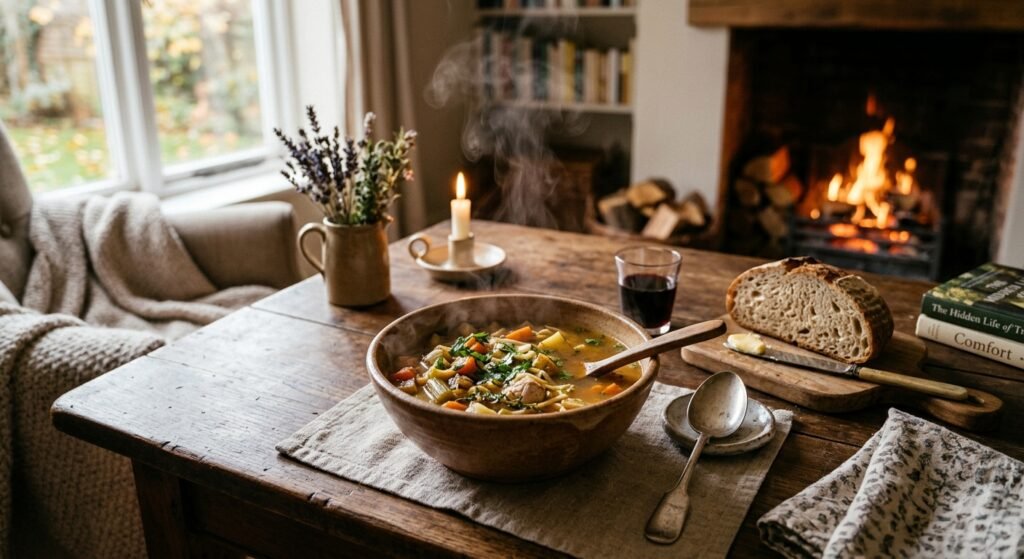
There’s a specific kind of quiet that fills the room when you set down a steaming bowl of soup on a long evening. You aren’t just looking for dinner. You’re exhausted, maybe nursing a scratchy throat, or simply worn down by a week that asked far too much of you. You wrap both hands around the warm ceramic, lean in to breathe in the steam, and take that very first slow sip.
Immediately, something inside you settles. It’s a reaction that goes far beyond satisfying physical hunger. It feels less like eating and more like taking a deep breath after holding it for hours. It feels like a moment of quiet shelter when you didn’t even realize how tired you were.
Most foods allow you to hurry. You can eat a sandwich while walking to a meeting, or finish a meal at your desk without ever looking away from your screen. Soup doesn’t allow that. If you try to rush it, you burn your tongue. It forces you to wait, to blow gently across the surface, and to pay attention to every single spoon full.
Why Soup Demands A Different Speed
In a life where almost everything encourages you to move faster, soup creates a rare pause. That enforced slowness gives your thoughts a chance to settle. You can’t multitask effectively when you’re holding a hot spoon, which means for a few brief minutes, you’re entirely present with what’s in front of you.
There’s a psychological reason why this feels so grounding. Researchers who study physical sensation and emotional regulation have found that warmth in the body directly affects how safe we feel. When warm liquid enters the stomach, it stimulates nerves that signal your body to rest and digest. The warmth literally tells your nervous system that the day’s tension is over and that it’s safe to relax.
That’s why a simple bowl of broth can alter your mood faster than a complex meal that takes hours to cook. The physical sensation communicates ease directly to your mind.
The Early Memory Of Being Looked After
For many people, soup is tied to their earliest experiences of care. Think back to staying home sick as a child. You were wrapped in a blanket on the couch, feeling small and vulnerable, and an adult brought you a simple bowl of soup. You didn’t have to prepare it, pay for it, or clean the pot afterward. Your only job was to receive it.
Decades later, taking a spoonful of hot broth taps right back into that emotional memory. Even if you cooked the meal yourself in an empty kitchen, the sensory experience carries the quiet echo of being looked after. It reminds you of a time when someone else was responsible for keeping you safe and comfortable.
Studies on sensory memory show that taste and warmth are tied deeply to emotional security. When you experience those sensations, your brain quietly recalls the feeling of being protected. It’s emotional comfort disguised as an ordinary meal.
Care In Its Simplest Form
There’s also something remarkably modest about soup. It doesn’t ask for complicated presentation or formal table manners. It’s gentle, forgiving, and easy on the body when everything else feels demanding.
When life feels chaotic or emotionally complicated, rich or complex foods can sometimes feel like too much effort. Simple food provides relief. It asks nothing of you except that you sit, sip, and let it do its quiet work.
It’s care in edible form. It’s the physical version of someone putting a hand on your shoulder and telling you that you don’t have to figure everything out tonight.
You Were Never Just Hungry
The next time you reach for a warm bowl when you’re feeling exhausted or out of energy, notice what you’re really seeking.
Maybe you aren’t just looking for nourishment or calories. Maybe you’re reaching for a feeling you haven’t experienced in a while. Maybe you’re looking for permission to slow down, rest, and be cared for, even if it’s just by yourself.
And maybe that’s the quiet truth beneath it all. Wanting to feel looked after isn’t something we ever outgrow. Sometimes, finding that comfort is as simple as sitting down with a warm bowl and letting yourself be restored, one slow spoon full at a time.