Can we talk about this for a second?
You’re sitting at a restaurant table, you’re about ninety percent full, and yet you’re currently doing subtle, highly specific arithmetic on your plate. You aren’t just eating anymore. You’ve entered the final phase of the meal, where every single bite is calculated to lead up to one ultimate forkful.
We’ve all done it. You look down at your food halfway through dinner and realize there’s one specific section that clearly represents the best part of the entire dish. Maybe it’s the corner of the lasagna with the extra crispy cheese. Maybe it’s the middle slice of a sandwich that has the exact right ratio of bacon, sauce, and toasted bread. Or maybe it’s just a single french fry that somehow achieved ideal golden perfection while every other fry on the plate settled for average.
Instead of eating that bite right away, you do something completely counterintuitive. You protect it. You quietly push it slightly to the edge of the plate, away from the general chaos, and you leave it there while you eat everything else around it.
The Art of the Decoy Bite
At some point, eating stops being about actual hunger and starts being about timing. You begin working your way through the remaining food like a person clearing clutter off a desk before starting a project. You eat the slightly dry crust. You clean up the lukewarm side dish. You consume pieces of food you aren’t even particularly excited about, all to clear the stage for that one reserved forkful.
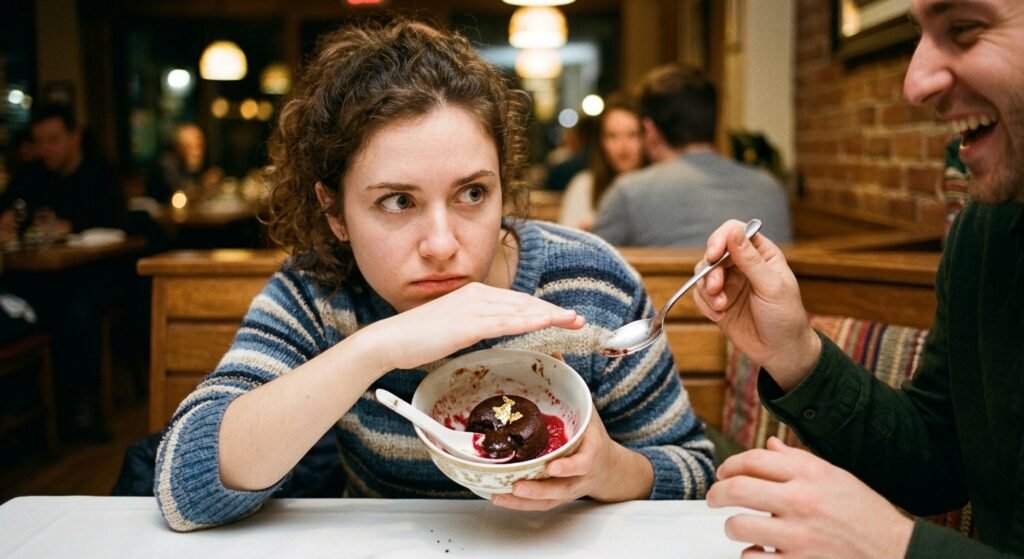
The situation becomes truly delicate when you’re dining with other people. You’ve spent ten minutes carefully managing your plate. You’ve positioned your ideal bite at the two o’clock spot on your dish, holding it in reserve. Then, out of nowhere, your friend smiles, reaches across the table with their fork, and says, “Ooh, can I try a bite of that?”
A momentary freeze occurs across your entire nervous system.
You want to be a generous friend. You want to share. But you also know that their fork is currently hovering directly over the precise piece of food you’ve been protecting like a rare collectible. Giving away that specific piece feels completely out of the question, yet explaining the real reason why you can’t give it away sounds slightly unhinged.
So you quickly perform under pressure. You jump into action, steering their fork toward a completely different section of the plate. You slice off a perfectly fine, totally respectable bite from the opposite side and hand it over with a warm smile. You say something like, “Here, try this part, it’s so good!” Crisis averted. Your plan remains intact, and nobody had to learn about the private food schedule you’ve been secretly keeping in your head.
When the Plan Falls Apart
There’s a real vulnerability to saving the best for last. Because when the plan works, it feels like a quiet personal victory. You take that final, perfect bite, lean back in your chair, set down your fork, and feel a wave of genuine satisfaction. The meal ended on a high note, and for a few minutes, everything in your immediate world feels organized and right.
But when the plan fails, the disappointment is surprisingly real.
Maybe you misjudged your appetite, and by the time you reach your final curated bite, you’re so full that you can’t even enjoy it. Maybe you accidentally drop it onto the napkin while lifting your fork. Or maybe you’re eating while watching a show, get distracted by a conversation or a plot twist, and absentmindedly chew through your prized bite without even paying attention.
The meal is technically over, but it feels completely wrong. You sit there looking at your empty plate, experiencing a tiny, ridiculous feeling of loss over a single bite of food that you were fully intending to eat anyway. It feels a bit like watching a movie that suddenly cuts to black right before the main character finishes their final sentence.
Why We Curate the Ending
It’s funny how much quiet thought we put into such a small moment. Our minds are strangely picky about how things end. We tend to remember experiences not by the average of every single minute, but by how the story concluded. A decent dinner that ends with a wonderful bite leaves us feeling like we had a great time. A great dinner that ends on a cold, soggy piece of lettuce leaves us feeling vaguely cheated.
We convince ourselves that saving that final piece is a small act of self care. It’s a tiny reward waiting for us at the end of the plate. In a day filled with unexpected emails, traffic delays, and minor surprises, managing the layout of our dinner plate is one area where we hold total, absolute control.
So we arrange the fries. We protect the cheese. We nudge the sauce into place. We quietly tell ourselves that if we can just get this one last detail right, the whole meal will count as an absolute victory.
And honestly? It usually does.
The next time you’re out to dinner and you see someone at your table quietly nudging a small piece of food to the corner of their plate, leave them be. Don’t ask for a bite. Don’t make a comment about it. Just give them a subtle nod of silent recognition.
They’re just trying to end their evening on a good note. And you’ll probably do the exact same thing when your own plate arrives tomorrow.