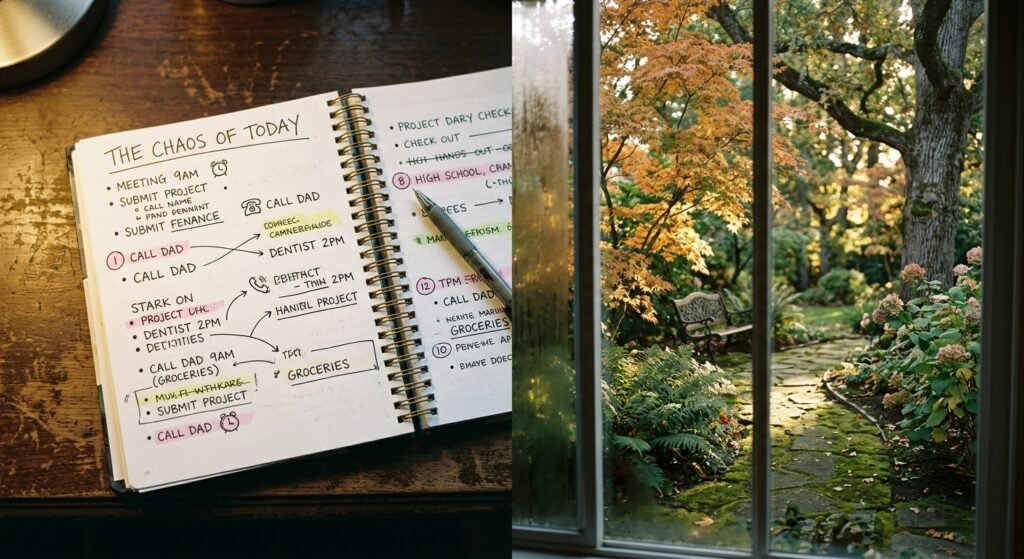
You open your phone on a Sunday evening to look at the upcoming week, and there it is: a beautiful grid of color-coded blocks. You’ve got blue for work meetings, green for exercise, yellow for dinner plans, and maybe a tiny sliver of grey for sleep. Looking at it, you might feel a brief spark of satisfaction. You’re active. You’re wanted. You’re making things happen. But then, a quiet, unsettling feeling creeps in. You realize that even though every single hour is carefully arranged, you aren’t actually looking forward to any of it.
It’s a common cycle. You find yourself rushing from a coffee date you didn’t really want to attend, to a workout class you’re too tired for, just so you can check them off your list. You’re late to a dinner with friends, feeling stressed in traffic, only to arrive and spend the evening thinking about tomorrow morning’s early routine. We’re physically present, but our minds are already driving to the next color-coded block. We’re moving constantly, yet we feel strangely empty.
The Safety of a Packed Day
We do this because staying busy keeps us safe from ourselves. There’s a classic study where researchers asked people to sit alone in a room with their thoughts for just fifteen minutes. There were no phones, no screens, and no distractions. The only object in the room was a button that would deliver a mild electric shock if pressed. Amazingly, a large number of the participants chose to shock themselves rather than simply sit quietly in the silence.
It turns out that being alone with our own minds can feel deeply uncomfortable. When we finally slow down, the quiet questions we’ve been running from have a way of catching up to us. We might start wondering if we actually enjoy our careers, if our relationships are genuinely fulfilling, or if we’re truly happy with the path we’re on. A packed schedule works like a shield. As long as you’re moving, you don’t have to answer those questions. You can tell yourself you’re simply too busy to worry about them.
The Difference Between Crowded and Full
Our culture loves to treat busyness as a badge of honor. When you ask a friend how they’re doing, the default response is almost always some version of being completely overwhelmed but good. It’s a way of telling others, and ourselves, that we’re important. If our calendars are crowded, then our lives must be meaningful. We mistake the speed of our days for the depth of our experiences.
But there’s a vast difference between a life that is crowded and a life that is full. A crowded life is about accumulation. It’s about how many commitments you can fit into twenty-four hours, how many invitations you can accept, and how many tasks you can complete. A full life, however, is about presence. It’s about having the space to actually taste your dinner, to listen to a partner without looking at your watch, and to sit quietly on a Sunday afternoon without feeling a wave of guilt.
Finding Joy in the Margins
When we look back on our favorite memories, they’re rarely the things we carefully planned or color-coded. They’re the unplanned conversations that stretched late into the night because nobody wanted to leave. They’re the slow mornings where nothing was urgent, or the spontaneous drives that led nowhere in particular. Those moments require empty space to exist. If every second of your day is claimed, you don’t leave any room for life to surprise you.
We don’t need to throw away our planners or cancel every commitment to find peace. That isn’t the goal. But perhaps we can start to see that a full calendar isn’t the same thing as a full life. Maybe the empty blocks on our screens aren’t gaps that need to be filled, but spaces where we’re allowed to catch our breath.
When you look at your calendar tonight, maybe you can leave a little room for nothing at all. Not for an errand, not for a chore, and not for a social obligation. Just a quiet space to let the day catch up to you. After all, we aren’t here to simply manage a schedule. We’re here to live.