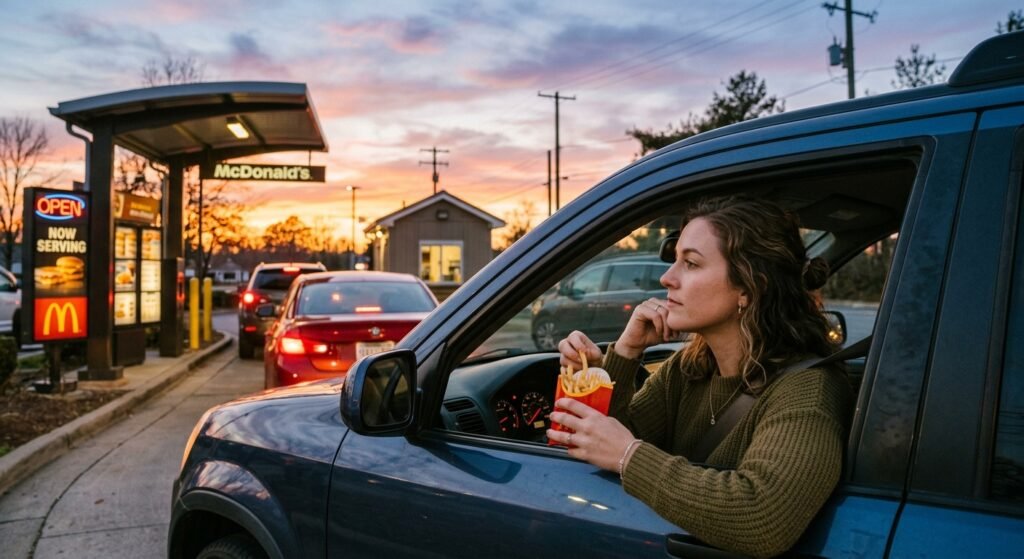
Can we talk about this for a second?
You’re driving home after a long day. You don’t actually need a fast-food meal. There is food in your refrigerator, or at least some leftovers that are still perfectly fine. But then you see the glowing menu board of a drive-thru, and before you even realize what you’re doing, your blinker is on.
You pull into the line. There are six cars ahead of you.
Usually, a long line makes you feel impatient. If you were at a grocery store checkout with six people ahead of you, you’d probably sigh, look at your watch, and wonder why they don’t open another lane. But here, in the quiet bubble of your car, a strange peace comes over you.
You put the car in park.
Suddenly, you’re not in a hurry anymore.
In fact, you might even feel a little relieved that the line is moving slowly.
The Magic of the Micro-Pause
Nobody talks about how the drive-thru line has become our unofficial decompression chamber. It’s the only place in the world where you’re completely allowed to do absolutely nothing. You can’t answer emails. You can’t fold laundry. You can’t start cooking. You are just a person sitting in a comfortable seat, waiting for a sack of warm food.
The first thing you do is turn down the radio.
You don’t turn it off, because total silence feels a little too dramatic. You just lower the volume until the music is a soft background murmur. Somehow this always happens. You need the quiet to think, or more accurately, to not think.
Then, you stare blankly at the bumper of the car ahead of you.
You read the license plate frame. You look at their bumper stickers. You wonder what their story is, but only for about three seconds before your mind drifts away again.
The Art of Doing Nothing
At some point, it stops being about the food.
Sure, you’re going to order something. You might even have a very specific craving. But the real treat isn’t the fries or the chicken nuggets. The real treat is the ten minutes of complete, uninterrupted transition time.
It’s the space between who you had to be today and who you have to be when you get home.
While you’re waiting, you start quietly talking to yourself.
You rehearse your order like you’re preparing for a major presentation. You’ve ordered this exact meal fifty times in your life, but for some reason, you feel the need to practice saying it out loud. You want to get the flow just right. You don’t want to get to the speaker and freeze up when they ask if you want to make it a combo.
“Hi, yes, I’ll have the number three with a diet soda,” you whisper to your steering wheel.
You nod. It sounds natural. It sounds confident.
Processing in Slow Motion
Then the car ahead of you moves up, and you slowly roll forward.
This is the moment where you start to process everything that happened since you woke up. You remember a weird email you sent at eleven in the morning. You think about a joke you made that didn’t quite land. You wonder if you should have bought those shoes you saw online last night.
It’s like your brain has been waiting for this exact slow-moving queue to finally unpack its bags.
If someone looked through your window right now, they’d just see you staring straight ahead with a slightly vacant expression. But on the inside, you are sorting through your entire day, putting things away in little mental folders.
We all know how this ends.
You finally reach the speaker. The voice on the other side asks for your order, and all your rehearsal goes right out the window. You hesitate. You say “uh” three times. You order something completely different than what you practiced because you panicked under the mild pressure of the moment.
The Journey Home
You pay at the first window. You grab your bag at the second window.
The employee smiles and says, “Have a nice evening.”
You drive away, and suddenly the spell is broken. You are back on the main road, the food is warm in the passenger seat, and you’re officially on your way home.
But as you eat that first fry in the driveway, you realize you feel just a little bit more relaxed.
Sometimes we need those little pauses in our day, even the ones that come with a side of dipping sauce. We don’t always need a long walk in the park or a quiet room to find our balance. Sometimes, all we really need is a slow-moving line, a steering wheel to rest our hands on, and a few minutes of doing absolutely nothing.
And honestly, we’ve all been there.
You’ll probably find yourself in that line again by the end of the week.