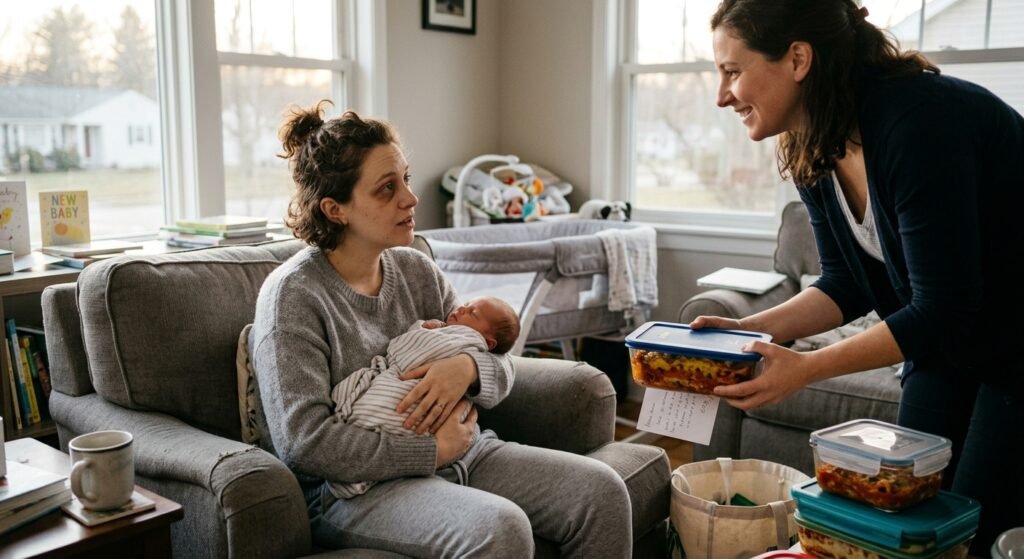
You stand on a porch holding a warm casserole dish wrapped in foil, listening to the soft, unfamiliar sounds of a home that has recently welcomed a newborn. When the door opens, you don’t see the put-together friend you had lunch with a few weeks ago. Instead, you see someone standing in the doorway with rumpled hair, wearing mismatched sweatpants, holding a tiny bundle against her chest. She looks beautiful, but she also looks entirely consumed by the sheer scale of what she is doing. You hand over the warm container, and for a split second, her eyes well up with tears. It isn’t because she was craving lasagna. It’s because for the first time in days, someone has looked at her and recognized, silently, what she needs to keep going.
There’s a quiet transformation that happens when a person transitions into parenthood. Suddenly, the entire world moves its gaze. During pregnancy, the expectant mother is the center of attention. People ask how she feels, pull out chairs for her, and check on her well-being constantly. But the moment the baby arrives, that spotlight moves. The focus lands entirely on the nursery, the sleep schedules, the feeding logs, and the tiny person who has just entered the room. The mother, who just went through one of the most intense physical and emotional events of her life, quietly fades into the background of her own home.
She becomes the caregiver, the one responsible for sustaining this new life. And because she’s so focused on that monumental task, she often forgets that she still has a body that requires nourishment, a mind that needs quiet, and a heart that needs comforting. When you bring a meal to a new mother, you’re doing something much larger than saving her thirty minutes of cooking. You’re gently redirecting the spotlight back to her, if only for a moment, and reminding her that she still exists outside of her utility to the baby.
The Deep Comfort of Being Fed
When we think about early postpartum support, we often think of holding the baby so the mother can sleep, or offering to fold a basket of laundry. Those things are deeply helpful, but there is something uniquely intimate about feeding someone. Food is elemental. It’s the first way we ever experience love as infants, held in someone’s arms. To have someone else prepare a warm meal, pack it up, and bring it to your door when you are at your most exhausted is a form of nurturing that reaches back into our earliest memories of safety.
Psychologists who study family dynamics and early parenthood often talk about the concept of holding the mother. In the early weeks, the baby needs to be held constantly to feel secure. But who holds the person who is doing all the holding? Without a circle of support, the caregiver can quickly feel isolated, carrying a profound sense of responsibility entirely on her own. Bringing a meal is a physical way of holding her. It’s saying, I see how much you are giving of yourself right now, and I want to give something back to you.
This kind of nourishing support acts as a beautiful signal of community protection. When a mother receives care from those around her, her nervous system receives a quiet message that she is safe, that she is not alone, and that her community has her back. That sense of security isn’t just nice to have; it’s a vital foundation that helps her face the daily demands of caring for a newborn with a little more resilience and peace.
The Struggle to Receive Help
One of the most complicated parts of becoming a mother is learning how to accept help. Many of us are conditioned to believe that we should be able to do it all. We see images of mothers who seem to balance recovery, household chores, and newborn care with ease. So when a friend offers to bring dinner, the immediate instinct is often to politely decline. We say we’re fine, we have leftovers, or we don’t want to be a bother. We worry about the state of our living room, or the fact that we haven’t showered, or that we won’t be good company.
But the truth is, accepting a meal requires a vulnerable surrender. It means letting someone see you in your undone state. It means admitting that you can’t do everything on your own, and that you actually need the community around you. When you deliver that food, you aren’t expecting a hosting performance. You don’t need a clean house or an entertaining conversation. You’re there to deliver comfort, place it on the counter, and leave before the baby wakes up again. It’s a quiet contract of trust, showing her that her vulnerability is completely safe with you.
And honestly, that’s why these small gestures matter so much. They teach us that we don’t have to earn care by being perfect. We don’t have to have everything figured out before we deserve to be fed. The act of receiving a simple meal on the kitchen counter becomes a gentle practice run for a lifetime of parenthood, reminding her that asking for help isn’t a sign of weakness, but a necessary part of staying whole.
A Quiet Circle of Care
There is a beautiful historical tradition in this simple act. For generations across different cultures, the period following birth was marked by a sacred time of recovery, where the community wrapped itself around the new mother. Neighbors and family members would take over the cooking, the cleaning, and the care of older children, allowing the mother to focus solely on bonding and healing. While our modern lives don’t always support this level of communal care, the instinct to bring food remains a lingering piece of that ancient wisdom.
When we feed the caregiver, we are participating in a quiet circle of care that keeps families afloat. We’re acknowledging that nobody was ever meant to do this alone. The warm soup or the freshly baked bread becomes a quiet bridge between her isolated bubble and the wider world outside, reassuring her that she’s still connected to a network of people who care about her well-being.
Eventually, the visitors will stop coming by as often. The baby will grow, the routine will become familiar, and the kitchen will once again smell like home-cooked meals made by her own hands. But the memory of those early weeks, and the specific taste of the food brought to her door by people who cared, will linger long after the freezer meals are gone.
Perhaps the real beauty of cooking for a new mother isn’t just about nutrition or saving her a chore. Maybe it’s the quiet realization that we don’t just need to care for the new life that has arrived. We need to care for the person who brought them here. Because when we nourish the mother, we aren’t just helping her get through another day of parenting. We are showing her that she is worth tending to, that her needs still matter, and that before she was ever a caregiver, she was someone’s cherished friend.