
The Unseen Audience in the Gallery
You are standing in a quiet corner of a grocery store, holding a jar of spicy mustard you don’t even particularly like. Your hand lingered on the shelf because it is the exact brand they used to buy. For a fleeting second, you imagine them looking into your shopping cart, nodding in approval, noting that you finally appreciate the finer things. You don’t buy the mustard, but as you walk away, you realize you’ve spent the last three minutes shopping for an audience of one who isn’t even in the store.
It is a quiet, almost invisible habit that many of us carry long after a partnership has ended. You aren’t calling them, and you certainly aren’t sending desperate late night texts. From the outside, you look like someone who has moved on completely. Yet, in the subtle choices of your day, they remain the silent editor of your life. You post a photo of a rainy coffee shop window not because you love the image, but because you know they would appreciate the mood. You read a challenging book because it is the kind of literature they always championed. You listen to a specific indie band, hoping that if they ever look at your public music profile, they will see you have matured.
This curation isn’t about desperation. It is about the lingering echoes of connection. When we love someone, we don’t just share a couch or a kitchen; we share a lens. We learn to see the world through their eyes, and even when the relationship ends, that lens doesn’t just shatter. We keep looking through it, wondering if the person on the other side is still looking back.
The Ghost in the Machine of Our Minds
We often treat breakups as clean breaks, like a door shutting or a page turning. But our minds don’t work in tidy chapters. When you spend months or years closely connected to another person, your brain actually restructures itself around their presence. Experts who study relational cognition point out that our very sense of self becomes intertwined with our partners. We share memories, habits, and daily rhythms until the boundary between where we end and they begin becomes beautifully blurred.
When that connection dissolves, the mental scaffolding remains. Research suggests that when a significant relationship ends, people experience a literal disruption in their sense of identity. It is not just that you miss the person; you miss the clear definition of who you were when you were with them. The quiet act of curating your life for them is a subconscious attempt to keep that identity from dissolving. By doing things they would approve of, you are keeping a small, familiar version of yourself alive.
It is a comforting illusion. As long as you are living for their hypothetical approval, you don’t have to face the quiet space where their feedback used to be. You get to pretend the conversation is still happening, even if you are the only one speaking.
The Performance of Moving On
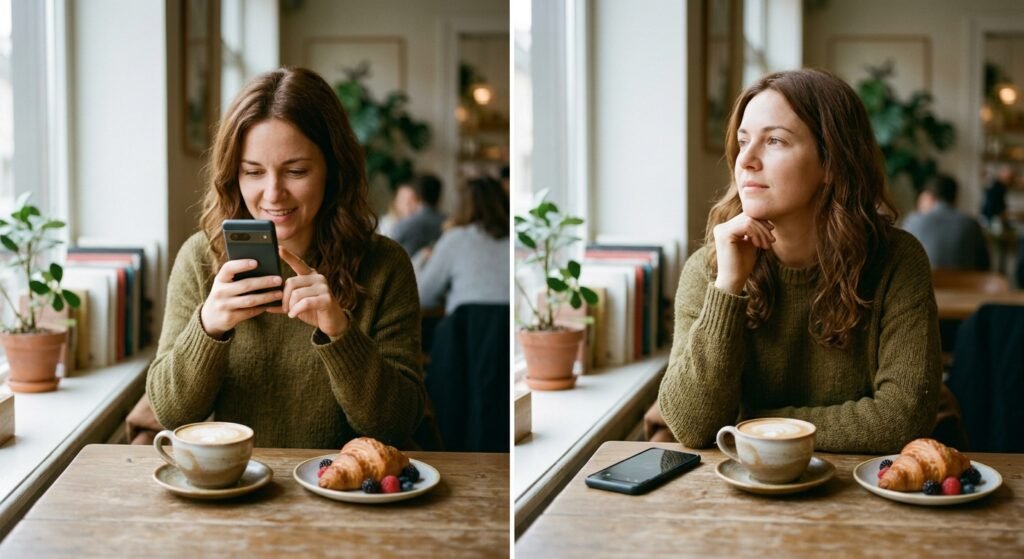
In our modern world, this silent performance has found a perfect stage. Social media allows us to send coded signals directly into the ether, hoping they land on one specific screen. We share the concert tickets, the hiking trail, the new outfit, and the clever caption, wrapping them up like little gifts for an observer who might not even be paying attention. We tell ourselves we are just sharing our lives with our friends, but deep down, we know exactly whose view count we check first.
This curation can feel exhausting because it requires a constant double consciousness. You can’t just enjoy a sunset; you have to consider how the sunset fits into the narrative of your recovery after the breakup. You can’t just buy a new jacket; you have to wonder if they would think it looks good on you. The present moment gets constantly filtered through the imaginary judgment of the past.
And the irony, of course, is that the person you are curating your life for is no longer the real person. They are a character you are keeping alive in your mind. The actual person has moved on, changed, and is living a life you no longer see. You are performing for a memory, dressing up for a ghost who has already left the theater.
Reclaiming Your Own Audience
There comes a moment when the curation starts to lose its charm. You find yourself doing something you genuinely dislike just to maintain the image, or you realize that the energy you spend wondering what they would think is keeping you from enjoying what is actually in front of you. That is usually when the quiet realization begins to settle in.
Maybe you aren’t actually trying to get their attention anymore. Maybe, in your own quiet way, you have been performing for them because you are afraid of what happens when the stage goes completely dark. You are afraid of the silence that comes when you stop trying to prove that you are okay, that you are growing, and that you are worthy of being missed.
But when you finally stop curating, something remarkable happens. You buy the mustard you actually like, or you don’t buy any at all. You post the messy, unfiltered photo, or you keep the moment entirely to yourself. You start realizing that the seat in the gallery is empty, and instead of feeling lonely, it begins to feel like a strange kind of freedom. You get to be the only person who needs to approve of your choices, and you finally get to live the life that belongs entirely to you. And honestly, that is a beautiful place to start.