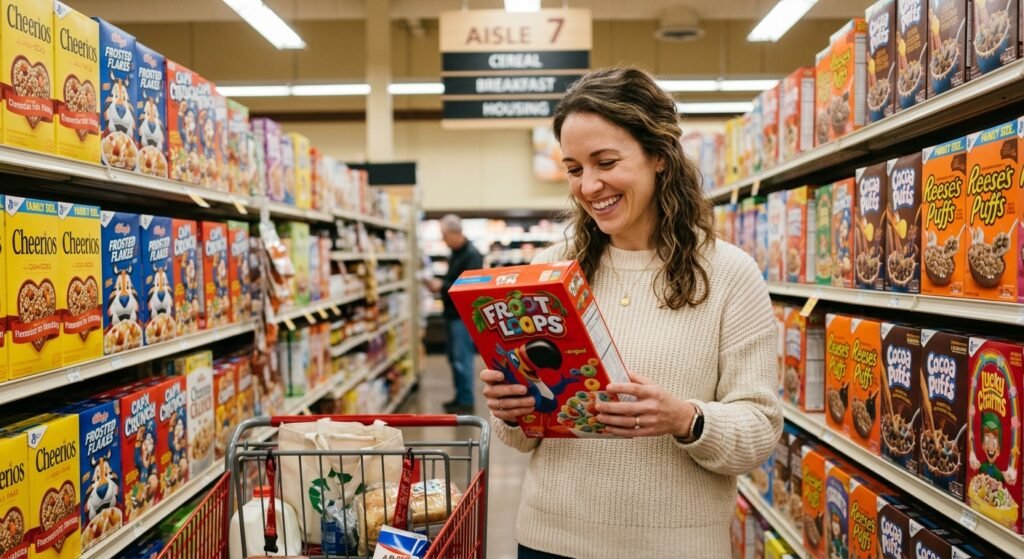
You’re walking down the cereal aisle on a quiet Tuesday evening, navigating the bright fluorescent lighting and the low hum of the refrigerators. Your mind is probably occupied with your busy list, your budget, or what you need to prepare for dinner tomorrow. Then, without warning, you freeze in front of a familiar glass jar.
It’s the exact brand of soup your grandfather always warmed up on chilly afternoons. In an instant, the busy store seems to fade away, and you aren’t just an adult running errands anymore.
You’re suddenly eight years old again, sitting at a laminate kitchen counter. You’re watching the afternoon sun stream through the window while someone who loved you prepares a snack.
This experience is surprisingly common, yet we rarely talk about how emotional a simple trip to the supermarket can actually be. We tend to view these stores as purely functional places, designed for commerce rather than feeling. Yet, the aisles we walk through every week are secretly filled with emotional tripwires, waiting to connect us back to our younger selves.
The Architecture of Hidden Memories
There’s a reason why grocery stores trigger these deep, quiet waves of nostalgia more effectively than almost any other place. It has to do with how our brains store our earliest experiences. When we’re young, we don’t just eat food; we absorb the entire environment surrounding it. The sights, the textures, the packaging, and especially the smells are all recorded together in a single sensory file.
Psychologists refer to this as sensory encoding, which is basically the way our minds bundle different sensations together when we experience something meaningful. Because our sense of smell and taste are wired directly into the emotional centers of our brains, food memories become remarkably durable. When you see that vintage label or catch a whiff of a certain spice, your brain immediately opens that old file, bringing back the entire emotional landscape of your childhood.
It’s not just about the product itself, but the safety and simplicity of the world that came with it. Back then, you didn’t have to worry about bills, career choices, or the state of the world. Your biggest concern was whether you’d get the toy inside the cereal box. When you encounter those familiar items today, you’re briefly touching a time when your life felt completely taken care of by someone else.
The Comfort of the Familiar
Research in consumer psychology suggests that we often seek out these familiar brands during times of transition or stress. When our adult lives feel chaotic or uncertain, our minds naturally crave predictability. Walking into a store and seeing the same green can of peas or the same red box of gelatin that you saw decades ago provides a subtle, comforting sense of continuity.
It acts as a reminder that even though your life has changed dramatically, some things remain exactly as they were. This continuity is a powerful emotional anchor. It helps us feel grounded when everything else around us is in motion, offering a quiet sanctuary of stability disguised as a grocery shelf.
We aren’t really longing for the taste of processed sugar or canned soup. We’re longing for the feeling of being small, protected, and free from the responsibilities that now occupy our daily thoughts. The grocery store becomes a physical museum of our personal history, with each aisle containing a different chapter of our lives.
The Realization Beneath the Cart
If you pay close attention, you might notice that the items that make you feel the most nostalgic are rarely the ones you buy today. You might smile at the sight of a certain chocolate syrup, but you don’t actually put it in your cart. You leave it on the shelf, choosing instead the organic, low sodium options that fit your adult lifestyle.
That’s because you don’t actually want to eat the food; you want to visit the memory. There’s a beautiful distinction between wishing to relive the past and simply wanting to honor it. Leaving the item on the shelf while carrying the warmth of the memory with you is a gentle way of acknowledging how far you’ve come.
Perhaps we don’t visit the grocery store just to feed our bodies. Maybe, on those quiet evenings when we find ourselves lingering in the center aisles, we’re also feeding our need to remember who we used to be. And in realizing that, we can appreciate that the ordinary places we inhabit every day are often the ones holding our most extraordinary treasures, waiting for us to notice them once again.