
Can we talk about this for a second?
You are standing in the middle of the grocery store aisle, holding two different jars of almond butter. One is normal. The other has a label that looks like it was designed by a minimalist architect, costs about the same as a streaming subscription, and proudly claims to be activated, stone-ground, and gently kissed by the morning sun. You stand there for five full minutes, comparing the ingredients, trying to decide if buying the regular one means you’ve officially given up on your future.
Somehow this always happens.
The Magic Basket of Control
You didn’t start the week planning to audit your pantry. But somewhere along the way, a switch flipped. Suddenly, the simple act of choosing what to eat became a high-stakes decision. You look down at your shopping cart and it looks like a beautiful, pristine garden. You have three different types of organic lettuce, a root vegetable you don’t actually know how to cook, and a tiny bottle of wellness shots that taste suspiciously like ginger-flavored battery acid. You feel a deep sense of accomplishment just looking at it.
At some point, it stops being about the food.
We all know how this ends. You spend forty dollars on organic greens that look like they were harvested from a magical forest. You pack them into the refrigerator with a careful touch, organizing them by color. You convince yourself that eating these leaves will somehow solve your problems, fix your sleep schedule, and maybe even help you finally reply to those emails you’ve been avoiding since last month.
It’s a beautiful little story we tell ourselves. We believe that if we can just control every single molecule that crosses our lips, we can keep the chaos of the outside world at bay. It’s a harmless little delusion that feels completely reasonable in the moment. If your calendar is a disaster, your kitchen counter is covered in junk mail, and you aren’t sure where your career is going, at least you can say with absolute certainty that your almond milk doesn’t contain carrageenan.
The Language of Food Rules
Nobody talks about how much work this is. You spend hours reading labels in the store, squinting at terms you can barely pronounce, trying to figure out if a specific starch is your friend or your enemy. For some reason, this suddenly feels like the most important project in your life. You feel like a detective solving a mystery, except the mystery is just whether or not you’re allowed to enjoy a cracker with your soup.
The funny part is the secret rules we invent along the way. We tell ourselves that certain foods have special powers. If a cookie is gluten-free, dairy-free, and sweetened only with the tears of organic maple trees, we convince ourselves it doesn’t count. We eat four of them while standing up in the kitchen, nodding to ourselves because we’re making healthy choices. Five minutes later, we’re still hungry because, as it turns out, a cookie made of compressed dust and hope isn’t actually a cookie.
But we keep going because the rules make us feel safe. When everything else feels unpredictable, the kitchen becomes the one place where we get to be the boss. We tell ourselves we’re doing it for our physical health, which sounds wonderful and responsible. But if we’re being completely honest with ourselves, sometimes we’re just trying to find a quiet corner of the day where we can have a little bit of order. It’s comfort wrapped in a green juice.
The Tuesday Night Realization
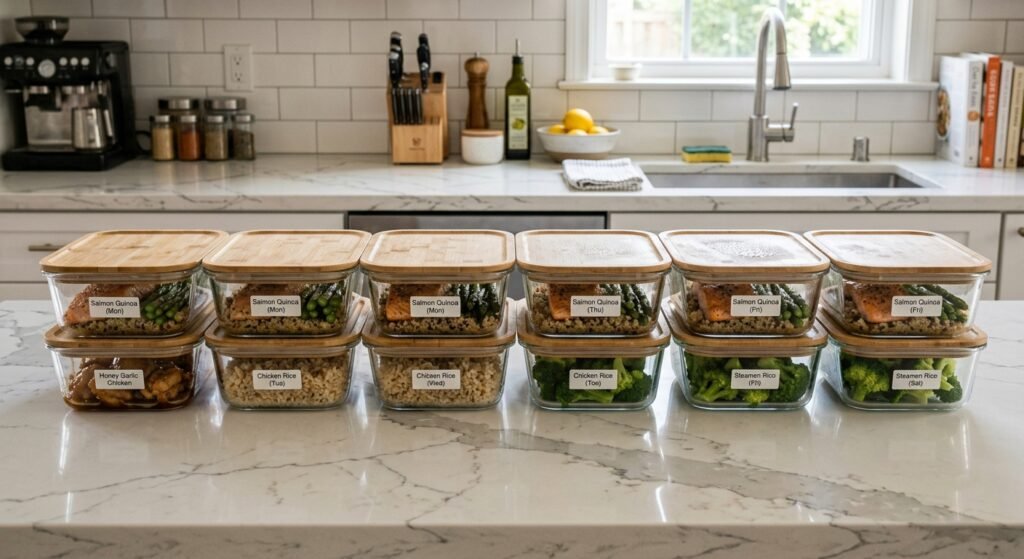
We look at the refrigerator and feel a tiny rush of pride when we see rows of glass containers filled with pre-washed, chopped vegetables. They are perfectly organized. They look like they belong in a lifestyle magazine. You stare at them and think about how clean your life is about to become.
Then, Tuesday evening arrives.
You had a long day. You’re tired. Your boss sent an email at five o’clock that changed your entire week. The thought of washing, chopping, and chewing through three cups of raw kale feels less like dinner and more like a second job. Your carefully constructed system suddenly feels exhausting.
So what do you do?
You order takeout.
And that’s the moment the spell breaks. You eat the noodles, you feel great, and the organic kale quietly begins its journey toward becoming liquid at the bottom of the crisper drawer. The transition from dedicated clean eater to someone eating cold pizza over the sink happens in about thirty seconds, and it feels surprisingly easy.
The next morning, you don’t feel ruined. The sky didn’t fall. The world kept spinning. You realize that your body is remarkably resilient, and that a single meal didn’t rewrite your entire future.
Finding the Balance
Maybe the lesson isn’t that we need to abandon our green juice or throw away our stone-ground almond butter. Those things are perfectly fine, and they taste great when you actually want them. The realization is just that a little bit of chaos is always going to find its way into our lives, no matter how clean we eat. We don’t have to protect ourselves from the day by treating our grocery list like a strict contract.
Sometimes the most healthy thing you can do is just relax and eat the regular peanut butter. It doesn’t make you a failure. It just makes you someone who wanted peanut butter.
So the next time you find yourself staring at a label in the grocery store, wondering if a specific preservative is going to derail your entire life, take a deep breath. Put the jar down. Or buy it. Either way, you’re doing just fine.
And honestly, we all do this. You’ll probably find yourself staring at the almond butter again next Sunday, trying to decide if the activated version is the secret to peace of mind. You’ll probably do it again tomorrow, and that’s completely okay.