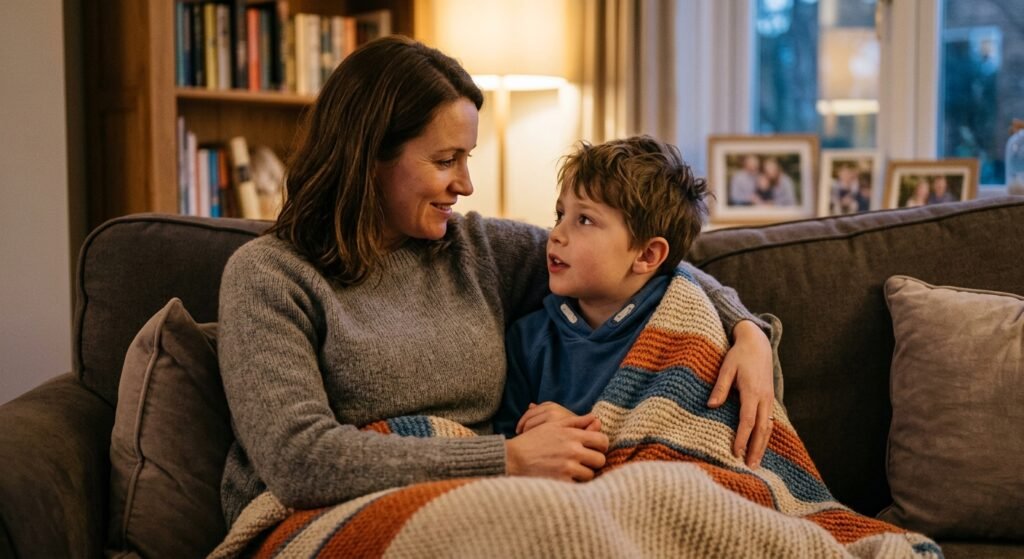
It usually happens in the middle of something completely ordinary. You might be slicing apples at the kitchen counter, waiting for the school bus, or trying to buckle a stubborn shoe, when a small voice from behind you asks a question so massive it makes the air in the room feel still. They might ask why the person on the street corner does not have a home, or why a beloved grandparent cannot remember their name anymore, or why people on the news look so angry at one another. In that fleeting second, the quiet safety of childhood bumps right up against the messy, unresolved realities of the adult world.
Your first instinct is almost always to protect them. You search for a shield made of words, trying to find a way to explain something you do not fully understand yourself. You want to soften the edges of the world, to keep the light in their eyes from dimming even a fraction. It is a natural, deeply tender impulse that every parent knows by heart. We want to keep them safe, not just from scraped knees, but from the realization that life can be unfair, unpredictable, and sometimes deeply sad.
But as you stand there with the apple half-sliced in your hand, you realize you cannot simply make up a fairy tale. Children are remarkably perceptive. They do not just hear our words; they read our pauses, our sighs, and the sudden tension in our shoulders. They can tell when we are offering a tidy lie instead of a complicated truth, and often, the mystery of what we are hiding feels far more frightening to them than the truth itself.
The Search for the Perfect Words
We often carry a quiet belief that if we are wise enough, patient enough, or articulate enough, we can find the perfect explanation. We look for a magical combination of words that will satisfy their curiosity without causing them a moment of worry. We want to package the complexities of life into a neat, digestible story that ends with a comforting moral. It is a beautiful goal, but it is also an impossible one because some realities simply do not have happy endings or clean explanations.
When you try to explain why a family has to move away, or why someone they love is very sick, you are not just translating facts. You are translating grief, change, and uncertainty. There are no textbooks for this because the emotions themselves are messy. If we wait until we have the perfect, polished answer before we speak, we often end up saying nothing at all, leaving them to navigate their questions in the dark.
People who study childhood development suggest that children do not actually need sophisticated, adult-level explanations to feel secure. What they are looking for when they ask these big questions is not a lecture on sociology or biology. They are testing the emotional climate of the room. They want to know if the adults around them can handle the topic without falling apart, and if it is safe to talk about the things that feel mysterious or frightening.
The Relief of Saying “I Don’t Know”
There is a quiet power in letting go of the need to be the expert on everything. When you tell a child that you do not know the answer, but that you are willing to wonder about it with them, something beautiful happens. You pull them close, you look them in the eye, and you share a moment of honest connection. You are showing them that it is okay to live with questions that do not have easy answers.
This approach transforms a potentially terrifying conversation into a shared journey. Instead of standing above them as an authority who has everything figured out, you are sitting beside them as a guide. You can say that the world is very big, and sometimes people make mistakes, or that sometimes bodies get tired and cannot be fixed, and that it makes you feel sad too. Sharing your own honest feelings, in a calm and contained way, gives them permission to feel their own feelings without shame.
Think about the moments when you have felt most supported during your own difficult times. It was rarely because someone gave you a perfect piece of advice or solved your problem with a clever phrase. It was because someone sat with you in the quiet, held your hand, and let you feel whatever you needed to feel. Children do not experience the world all that differently from us. They do not need us to fix the world; they just need to know we are standing with them as they learn to live in it.
Building a Bridge, Not a Shield
When we look back on our own childhoods, we often remember the moments when the curtain was pulled back just a little. We remember the quiet conversations overheard from the hallway, or the sudden, serious tone of our parents’ voices. Those moments can feel unsettling if they are left unexplained, leaving a child to fill in the blanks with their own imagination, which is often far more dramatic than reality.
By choosing to speak openly, we are not stripping away their innocence. Instead, we are helping them build the emotional resilience they will need for the rest of their lives. We are teaching them that difficult things can be talked about, that sadness is a natural part of living, and that love does not disappear just because things get complicated. We are helping them make sense of the world in small, manageable pieces, rather than leaving them to figure it out all at once when they grow older.
It is a slow, ongoing process. A single conversation will not solve everything, and they will likely ask the same question again next week, or next year, as they grow and understand a little more. Each time they ask, they are not looking for a new lecture. They are simply checking to see if the bridge we built is still there, and if we are still willing to walk across it with them.
Perhaps that is the real truth behind these difficult conversations. We spend so much time worrying about how to protect their innocence, wondering how to shield them from the hard realities of life, that we miss what they are actually asking of us. Maybe our job was never to keep the world’s difficulties a secret. Maybe our job is simply to ensure that as they discover those realities, they never have to carry them alone.