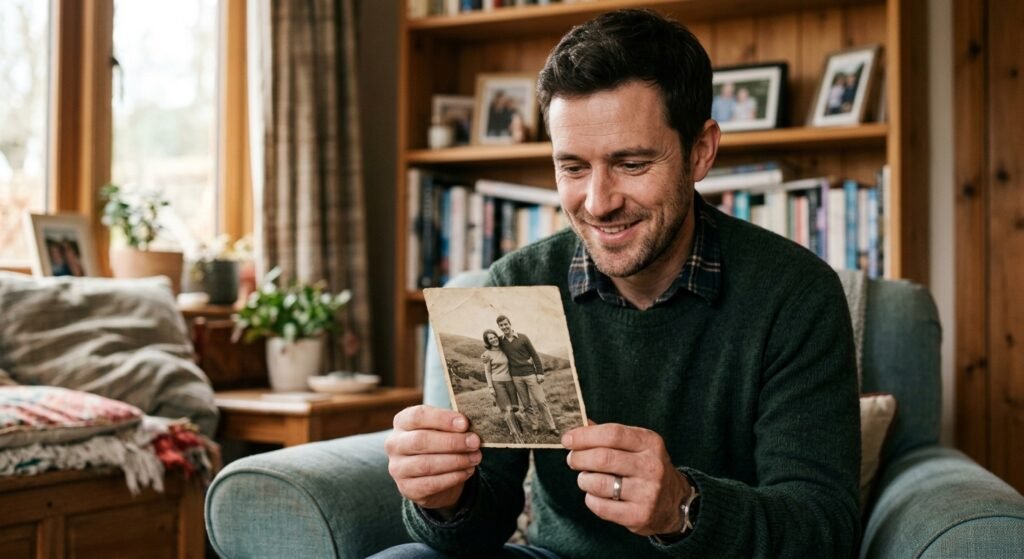
You’re clearing out a kitchen drawer, looking for a spare set of batteries, when your hand brushes against something unexpected. It’s a plastic keychain from a diner that closed down five years ago, or maybe a folded receipt from a weekend trip you took back when your knees didn’t ache when you walked too far. Suddenly, you’re not standing in your kitchen anymore. You’re sitting in a booth with cracked vinyl seats, laughing at a joke you can’t quite remember, smelling the faint scent of coffee and maple syrup.
For a brief second, a quiet ache pulls at your chest. It’s a familiar, soft sting, the kind that makes you want to hold onto the moment just a little longer while simultaneously wishing you could put it back where you found it. We’ve all experienced these sudden ambushes of memory. They happen in the middle of a grocery store aisle when a song from college plays over the speakers, or when you catch a whiff of a specific laundry detergent on a passing stranger.
We often treat these moments of looking back as a form of quiet sadness. We assume that because we feel a pinch of sorrow, we must be grieving the passage of time or wishing we could turn back the clock. It’s easy to look at that nostalgia and feel as though we’re failing to appreciate the lives we’ve built in the present. You might wonder why your mind keeps drifting back to an old apartment, a former job, or a friendship that slowly faded into holiday cards.
But memory is rarely as simple as a desire to repeat the past. When we look closer at how our minds handle these backward glances, we discover something far more comforting. Psychologists who study the way we process memory suggest that nostalgia isn’t actually a sign of unhappiness or a refusal to move forward. Instead, it serves as an emotional anchor, especially during times of transition. When the world around us changes quickly, our minds naturally reach back to find the threads of who we used to be, helping us feel whole.
Think of it as a mental reserve we build up over a lifetime. Researchers have found that when people actively engage with warm memories, they experience a boost in optimism and a greater sense of connection to those around them. It’s not an escape from reality; it’s a resource that helps us face the future. When you feel that familiar ache, your mind isn’t trying to drag you backward. It’s simply reminding you of your own capacity to belong, to care, and to be cared for.
The Beauty of What We Leave Behind
It’s easy to romanticize the past, filtering out the arguments, the unpaid bills, and the daily anxieties that existed alongside the good times. We remember the magic of that summer road trip, but we forget the flat tire or the hours spent bickering over directions. That isn’t dishonesty on the part of your brain; it’s a gentle sorting process. Your memory doesn’t store events like a security camera; it stores the emotional truth of how those moments shaped you.
Consider the way we look back on parenting young children, or the early days of starting a career. At the time, those seasons often felt exhausting, stressful, and chaotic. You were probably sleep-deprived, worried about money, and constantly wondering if you were making the right choices. Yet, years later, you might find yourself looking at an old photograph of a messy living room with a deep sense of warmth. You don’t miss the exhaustion, but you deeply miss the sweetness that lived inside it.
This tells us something important about how we value our experiences. Often, we’re so busy living through a chapter that we don’t have the room to appreciate its beauty. We’re too close to it, too caught up in the logistics of getting through the day. Nostalgia is the space that opens up after the chapter has closed, allowing us to finally see the picture clearly without the static of daily worries.
A Soft Way of Saying Thank You
Perhaps the mistake we make is assuming that missing something means we want it back. We worry that if we feel nostalgic for an old relationship or a former version of ourselves, it means we’re discontent with our current reality. But love and appreciation don’t have expiration dates. You can be deeply grateful for the life you have today while still holding a quiet reverence for the chapters that came before.
When you look at it that way, the ache of nostalgia changes color. It stops feeling like a loss and starts feeling like a tribute. That soft sting you feel when you hear an old song or look at a dusty photograph isn’t a sign of regret. It’s just gratitude wearing a different coat. It’s your mind acknowledging that something in your past was so beautiful, so meaningful, and so full of life that it left a permanent mark on your heart.
Missing those moments isn’t a problem to be solved or a sadness to be cured. It’s the evidence of a life well-loved. It means you were there, you felt it, and you let it matter to you. And maybe you don’t need to go back to those old places or rewrite those past chapters to feel that warmth again. You just have to realize that the beauty you’re missing didn’t stay behind in the past. It’s still right here, carried within the person you became because of it.