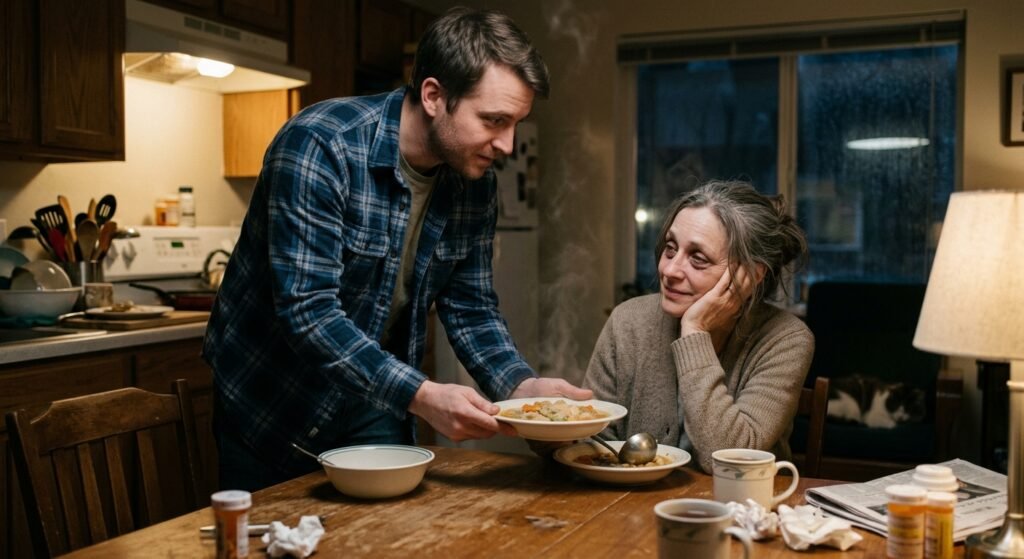
If you’ve ever watched the person who runs your kitchen after a long family gathering, you’ve probably noticed a quiet routine. While everyone else is sitting on the couch with full bellies, chatting and laughing, this person is still on their feet. They are wiping down counters, packing leftovers into containers, and finally, standing over the sink eating a cold slice of turkey or a piece of crust with their hands. It’s a familiar sight in almost every home, yet we rarely pause to think about what it actually means.
The person who feeds everyone else is often the last one to actually eat. They’ve spent hours, maybe days, planning the menu, checking grocery lists, worrying about who doesn’t eat dairy, and making sure there’s enough of everything. By the time the food actually hits the table, their appetite has often vanished, replaced by a quiet exhaustion. They spend the meal jumping up to grab more napkins, refilling water glasses, and making sure everyone else has the best portion. They are present, but they are also working.
The Silent Language of Sustenance
We tend to think of cooking as a chore or a hobby, but emotionally, it’s something much deeper. Since the beginning of our lives, food and care have been completely tangled together. When we are infants, being fed is our very first experience of safety and love. As we grow, the person who prepares our meals becomes the symbol of security. So when someone takes on the role of the family cook, they aren’t just managing ingredients. They are carrying the quiet responsibility of keeping everyone safe, comforted, and connected.
Family researchers often talk about the concept of emotional labor, which is the unseen mental effort required to keep relationships running smoothly. Feeding a family is perhaps the most physical form of this labor. It requires a constant, silent awareness of other people’s desires, moods, and physical needs. You have to remember that your partner had a bad day and needs comfort food, or that your child is going through a phase where they only eat green things. It’s a beautiful way to show love, but carrying that awareness day after day can eventually leave a person feeling emotionally depleted.
When you are always the one offering care, you slowly learn to quiet your own needs. You start to believe that your job is to sustain, not to be sustained. And because you do it so well, the people around you can easily forget that you have a hunger of your own, one that has nothing to do with food.
The Burden of Being the Anchor
It’s surprisingly easy to take the family caretaker for granted, not out of cruelty, but because they make the role look entirely effortless. They seem to find genuine joy in serving others, and they do. But there’s a difference between choosing to care for people and being the only one who ever holds the spoon. When a caretaker is always the one pouring the tea, they eventually run out of things to give.
Many caretakers struggle to ask for help because they’ve built their entire identity around being dependable. To ask someone else to cook or to take over the kitchen can feel like admitting defeat, or worse, like putting a burden on someone else. So they keep going, quietly making the soup, roasting the chicken, and pretending that they don’t mind eating the broken pieces that nobody else wanted. They convince themselves that they are fine, even as they look at a kitchen counter with a sense of quiet dread.
What they actually need isn’t just a break from the stove. They need to experience the relief of being considered. They need to know that someone is paying attention to their preferences, their hunger, and their comfort, just as they have done for everyone else for years.
The Relief of the Simple Sandwich
If you want to understand the heart of a caretaker, watch what happens when someone else makes them a simple sandwich. It doesn’t have to be a fancy meal or a complicated recipe. In fact, a simple grilled cheese made by a partner or a child can sometimes bring a caretaker to the edge of tears. It’s not about the taste of the cheese or the crispness of the bread. It’s about the sudden, beautiful absence of decision-making.
For a caretaker, the hardest part of feeding people isn’t the physical act of cooking. It’s the mental load of deciding what to make, ensuring it’s done on time, and hoping everyone likes it. When someone else takes over, even for a single evening, that entire load vanishes. The caretaker is allowed to sit down, keep their hands in their pockets, and simply receive. They don’t have to think about what ingredients are in the fridge or what needs to be cleaned up afterward. They are finally allowed to be the guest in their own life.
This is where we find a deeper truth about how we care for each other. Sometimes, the most generous thing you can do for someone isn’t helping them do their job. It’s stepping into their space and letting them know they don’t have to do it at all right now. It’s about offering them the same safety they’ve spent a lifetime building for you.
Maybe the caretaker in your life isn’t actually tired of cooking. Maybe they are just tired of carrying the silent responsibility of keeping everyone safe and sustained. And maybe being fed by someone else is the ultimate form of being held.
The next time you see the person who always feeds everyone standing in the kitchen, don’t just thank them for the meal. Offer to make the next one. Pour them a glass of water, pull out a chair, and tell them to sit down. Because everyone, no matter how strong or giving they seem, deserves to experience the comfort of looking at a plate of food and knowing that someone made it just for them, with love, to make their day a little easier. It’s a small gesture, but it’s one of the gentlest ways to say, I see you, and it’s your turn to be cared for.