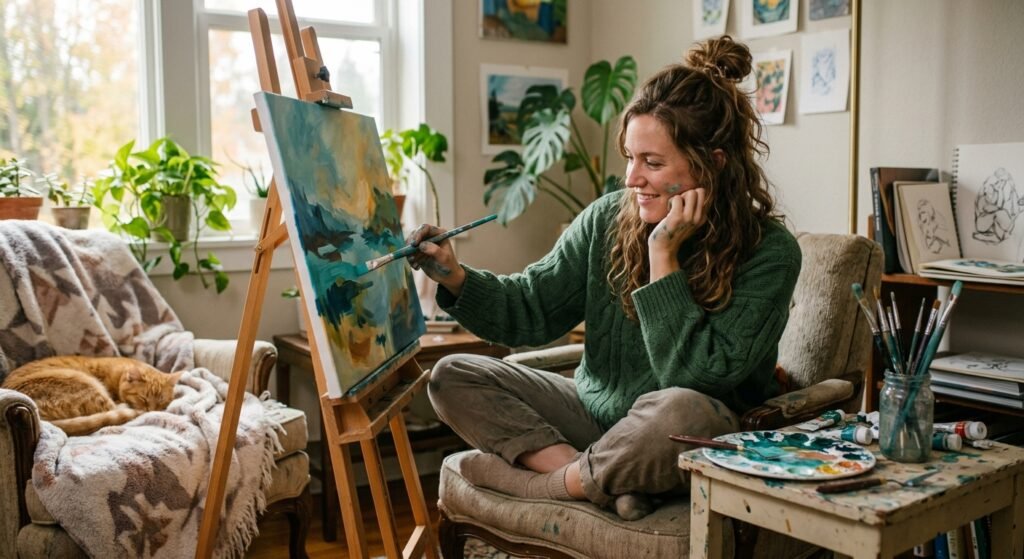
The Seductive Allure of the Side Hustle
It usually starts with a compliment. You spend a quiet Sunday afternoon baking sourdough bread, throwing clay on a pottery wheel, or painting watercolor landscapes at your kitchen table. For a few hours, the world slows down. You aren’t checking emails, you aren’t thinking about your calendar, and you aren’t trying to prove anything to anyone. You’re simply enjoying the feel of the materials in your hands. Then, a thoughtful friend looks at what you made and says the words that change everything: “You’re so good at this, you should sell it.”
It feels wonderful to hear. It feels like validation of your talent and your time. So, you start thinking about it. You open an online shop, set up a social media page, or start taking custom orders from people in your neighborhood. You tell yourself that it’s the ultimate dream: getting paid to do what you love. But then, a few weeks or months into the venture, something strange happens. The hobby that used to rescue you from stress starts creating its own brand of anxiety.
When Play Becomes Performance
Suddenly, you aren’t just creating for the joy of it. You’re thinking about shipping costs, packaging materials, and customer feedback. The watercolor painting isn’t an experiment anymore; it’s inventory. If you make a mistake, it isn’t a funny part of the learning process; it’s a waste of expensive supplies and precious time. The quiet sanctuary of your kitchen table has turned into a miniature assembly line, and the pressure to produce starts to feel remarkably like the pressure you feel at your day job.
Those who study motivation have noticed a fascinating pattern in how our minds handle rewards. When we start getting paid for something we naturally love doing, our inner motivation often begins to decline. Psychologists refer to this as a change in why we do things. When the reward comes from inside us, like the simple pleasure of playing an instrument or knitting a scarf, we feel a deep sense of freedom. The moment an external reward like money or public approval enters the picture, our brain quietly begins to view the activity as work. The play gets reclassified, and with that change, the magic starts to fade.
The Value of Being Mediocre
We live in a culture that looks at an unproductive afternoon with a hint of suspicion. We’re told to optimize our schedules, monetize our talents, and turn every passion into a stream of income. There is a quiet, constant pressure to prove our worth through our productivity. If we have a talent, we feel we are wasting it if we don’t try to grow it into something bigger. We forget that the primary value of a hobby isn’t what it produces, but what it restores within us.
When you turn a passion into a business, you lose the freedom to be bad at it. You can’t make a messy, ugly piece of pottery just to see what happens when you’re trying to fill an order for a paying customer. But some of the greatest joys of a hobby come from the mess. It’s the one area of life where you don’t have to be an expert, where you don’t have to be efficient, and where you’re completely allowed to be mediocre. Reclaiming that space means giving yourself permission to do things simply because they make you happy, without any expectation of a return on investment.
The Profound Relief of Letting Go
Deciding to pull back and let your passion return to being just a hobby can feel like a confession of failure at first. You might worry that you’re quitting or that you didn’t have what it takes to succeed. But as soon as you close the shop, delete the business account, or tell people you aren’t taking orders anymore, a different feeling usually takes over. It’s a deep, quiet sense of relief.
You realize that protecting your joy is far more valuable than trying to turn it into a profit. The watercolor brushes go back to being tools of exploration rather than instruments of production. You can paint a terrible picture, laugh at it, throw it away, and start over without feeling like you’ve lost anything. You’ve rescued your sanctuary from the marketplace, and in doing so, you’ve remembered why you loved it in the first place.
Maybe we aren’t meant to squeeze every drop of productivity out of our lives. Perhaps the most successful hobbies are the ones that never make a single dollar, but instead keep us connected to a part of ourselves that doesn’t care about success, algorithms, or bank accounts. Sometimes, the best way to honor a passion is to keep it small, keep it private, and let it belong entirely to you.