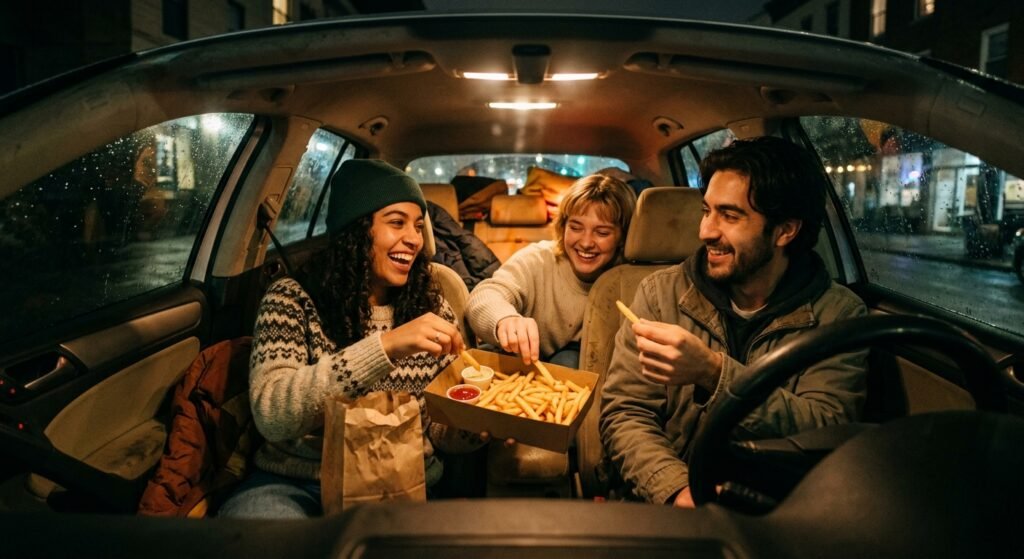
You’ve probably found yourself in this exact spot at least once. It is late, the streets are quiet, and you are sitting in a parked car with the engine idling just enough to keep the heater humming. Between you and the person in the passenger seat sits a greasy paper bag, radiating warmth and the unmistakable aroma of salty fries. You could go home, and you could certainly find a more comfortable place to sit than a molded bucket seat. Yet, you both stay, passing a tub of sweet and sour sauce back and forth in the soft glow of the dashboard lights.
There is a strange, almost sacred quality to these moments. We don’t plan them. They usually happen on impulse, a spontaneous decision to pull into a drive-thru lane after a movie, a long shift, or a road trip that ended too quickly. But once you park under the amber light of an empty lot, the rush of the day slows down. Eating fast food in a car doesn’t feel like a hurried meal. It feels like an escape.
In those moments, the rest of the world is paused on the other side of the glass. The car becomes a tiny, mobile living room where the normal rules of adulthood don’t seem to apply. You are eating with your hands, wiping salt on your napkins, and talking about things you would never bring up over a formal dinner table. It is simple, it is unpretentious, and it is quietly one of the most connecting experiences we can share with another person.
The Architecture of a Shared Bubble
Think about how different this is from eating at a restaurant. When you sit across from someone at a candlelit table, there is an unspoken pressure to perform. You have to navigate menus, wait for servers, keep your posture straight, and maintain consistent eye contact. It is a lovely experience, but it requires a certain amount of social energy. You are constantly aware of the people around you, the volume of your voice, and the way you are presenting yourself.
Inside a car, all of that pressure evaporates. You aren’t sitting opposite each other; you are sitting side-by-side. Interestingly, relationship experts have long noted that shoulder-to-shoulder positioning is often much more conducive to vulnerable conversations than sitting face-to-face. When you are looking out the windshield together at a darkened parking lot or a rainy street, you don’t have to manage the intensity of direct eye contact. The pressure is off. You can let a silence stretch out for a minute without it feeling awkward.
This side-by-side dynamic creates a unique emotional safety. Because you are both looking at the same view, you are aligned. You are partners in a small, self-contained universe. It is much easier to confess a secret, admit a doubt, or share a silly childhood memory when you are staring at the neon sign of a gas station rather than looking directly into someone’s eyes. The environment invites a relaxed honesty that is hard to manufacture anywhere else.
The Power of Low-Intensity Togetherness
Social researchers who study close bonds often talk about the concept of shared low-stakes environments. When we engage in highly structured activities, our minds are busy processing rules, expectations, and goals. But when we are doing something low-stakes, like dividing up a box of chicken nuggets in a dark parking lot, our minds drop into a state of relaxed playfulness. There is no agenda. There is no goal to achieve. You are simply occupying the same space, sharing a sensory experience that is inherently comforting.
There is also a comforting regression that happens when we eat fast food. For many of us, these flavors are deeply nostalgic, connected to childhood rewards, high school road trips, or college late nights. When you share these foods, you are quietly tapping into those early memories. You are stripping away your professional titles, your adult responsibilities, and the polished versions of yourself that you present to the public. You are just two people enjoying something simple and slightly indulgent.
This shared regression acts as a social equalizer. It is hard to hold onto pretense or try to impress someone when you are both trying to catch a stray fry before it falls into the gap between the seats. The physical limitations of the space force you to cooperate. You hold the dipping sauce for them, they pass you the napkins, and you coordinate who gets the last onion ring. These tiny, physical gestures of care and cooperation build a quiet rhythm of closeness.
The Safest Place in the World is Parked
We live in a world that constantly demands our attention, our productivity, and our best selves. Our homes are filled with chores, smart devices, and the quiet pressure of things we should be doing. Our workplaces require us to be focused and professional. Even our social outings can feel like events we need to curate for others. But the parked car is a twilight zone. It is a transitional space where you are neither here nor there.
When you sit in a parked car, you have successfully escaped your obligations for a little while. You are in limbo, and that limbo is deeply sweet when shared with someone you trust. The damp night air, the rhythmic swipe of the windshield wipers, or the distant hum of traffic only highlights the warmth inside the cabin. You are protected. You have food, you have shelter, and you have company.
It is during these quiet, unstructured intervals that the deepest conversations tend to slip out. You might start by complaining about a coworker, but an hour later, you are talking about your fears of growing older, your memories of a lost family member, or the dreams you haven’t written down yet. The mundane act of eating fast food becomes the passport that lets you travel into these deeper emotional territories together.
Perhaps that is the real secret behind why we stay in the car long after the food has gone cold. It was never actually about the quick meal or the convenience of the drive-thru. Maybe we park in the dark because the car is the only sanctuary left where the demanding expectations of the world cannot reach us. And passing a paper bag back and forth is simply our quiet way of saying that in a fast and complicated life, there is nowhere else we would rather be than right here, in the middle of nowhere, with each other.