
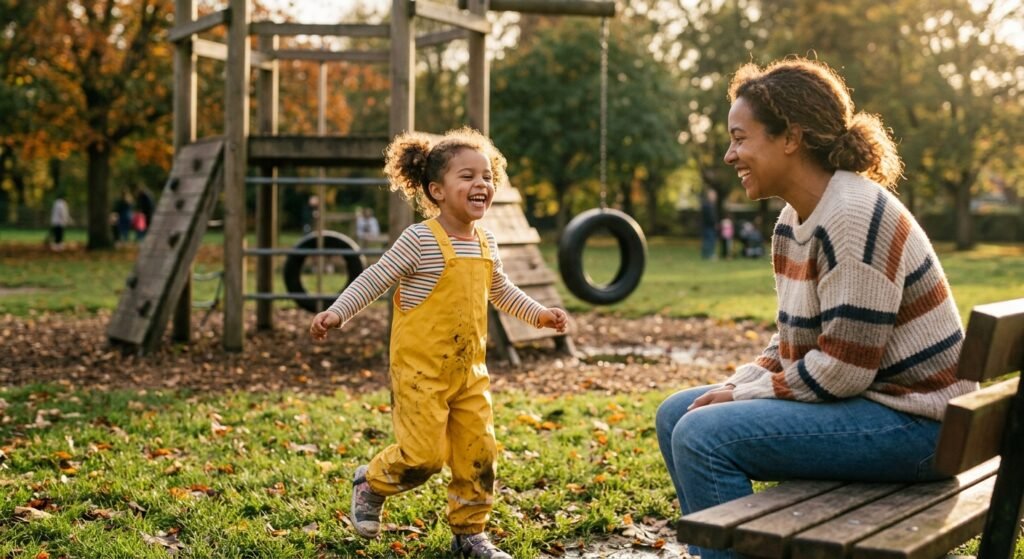
If you’ve ever sat on the living room floor watching your child build a tower of blocks, only to see it collapse and watch them simply laugh, you might have felt a sudden, unexpected sting in your chest. It isn’t a bad feeling, but rather a quiet, profound realization of how differently they experience the world. They don’t scramble to clean up the blocks in a panic. They don’t look over their shoulder to see if someone is about to get angry. They just sit there, safe in the knowledge that a mistake is just a mistake.
For many of us, growing up was an exercise in reading the air. You learned to listen to the sound of footsteps coming down the hall, determining by the pace whether it was a good day or a bad day. You knew which questions not to ask, which topics to avoid, and how to make yourself small when the household felt fragile. It was an environment where peace was temporary and unpredictability was the only constant.
Then, years later, you find yourself in your own home with your own family. You watch your child make a loud, messy mistake, and instead of freezing, they look up at you with complete trust. They expect comfort, not conflict. They ask for help, not forgiveness. In that tiny, ordinary moment, you realize something extraordinary: they have absolutely no idea what your childhood felt like.
The Unspoken Lessons We Didn’t Pass Down
When you grow up in a home where you have to be the adult before you’re ready, you learn to pay attention to everything. You become highly sensitive to changes in tone, the way a door closes, or the long silences that sit at the dinner table. It is a survival strategy, a way to keep yourself safe by anticipating everyone else’s needs before they even know they have them. You assume that this vigilance is just how life is, and you carry it with you long after you leave home.
But when you have children of your own, you start to see that vigilance isn’t a natural state of being. It is something that is learned when peace is hard to find. When you watch your child sleep deeply, completely unconcerned with the world around them, you start to see how much energy you had to spend just trying to feel secure. You realize how much of your early life was spent waiting for the next storm to arrive.
And that is where the deep comfort begins. Because you look at this little person and realize they don’t have those same defenses. They don’t need them. You’ve built a home where they are allowed to be soft, messy, and loud. You’ve given them the freedom to simply be kids, without the burden of having to manage the emotions of the adults in the room.
The Quiet Triumph of Earned Security
People who study family dynamics often talk about how patterns travel across generations. There’s a lot of focus on how we inherit the reactions, the defenses, and the quiet anxieties of those who raised us. But developmental experts also point to a concept called earned security. It’s the idea that even if your early life was unstable, you can consciously build a secure, loving reality for yourself and your family. It doesn’t happen overnight, but rather through a thousand tiny, daily decisions to react with patience instead of anger, and warmth instead of distance.
Research shows that children who grow up with this kind of emotional stability don’t spend their energy trying to protect themselves from their caregivers. Instead, they use that energy to explore, learn, and simply exist. Their minds aren’t busy trying to decode the adults around them because they already know they’re safe. When you look at your child’s easy confidence, you’re seeing the tangible results of your own quiet determination to do things differently.
This doesn’t mean you’re a perfect parent. Nobody is. You still get tired, you still make mistakes, and there are days when the patience runs thin. But the difference is that your child knows a bad day is just a bad day. It isn’t a threat to their safety or their sense of belonging. They don’t have to wonder if they are still loved when things get difficult.
The Soft Grief of Being the One Who Broke the Cycle
It can feel strange to realize you’ve successfully protected someone from a pain they will never truly understand. You might find yourself wishing someone had done the same for you. There can be a soft, lingering grief for the little person you used to be, the one who had to carry so much responsibility so early. It’s natural to feel a bit envious of your own child’s ease, even as you work tirelessly to preserve it.
You might look at them and think about how nice it must be to grow up without that constant undercurrent of worry. You might wonder who you would have become if you had been allowed to play, make mistakes, and be messy without the fear of consequences. It’s a quiet sorrow that many cycle-breakers carry, a reminder of what was lost along the way.
But more than grief, what usually remains is a deep, settling sense of gratitude. You realize that the cycle stopped with you. The unspoken rules you had to learn aren’t being passed down. Your child doesn’t have to learn how to heal from their childhood because they’re allowed to simply live it.
A Gentler Beginning
Ultimately, this is what healing looks like. It isn’t about erasing the past or pretending that the difficult parts of your life never happened. It is about taking the pain you experienced and turning it into a shield for someone else. It is the understanding that while you couldn’t change the beginning of your own story, you have the power to write a completely different opening chapter for your child.
And maybe that’s the most beautiful part of being a parent. You don’t need your child to understand the sacrifices you’ve made or the battles you’ve fought to keep them safe. You don’t need them to appreciate the calm because they’ve never known the storm. Their peace is the only proof you need that you did it right.
So the next time you watch your child spill their drink and look up at you with nothing but a simple request for a paper towel, take a deep breath. Let yourself feel the quiet triumph of that moment. They don’t know the fear you knew, and that is your greatest success. You’ve given them a childhood that is light, free, and wonderfully ordinary, and in doing so, you’ve quietly given yourself the greatest gift of all: the knowledge that the cycle has finally been broken, and you’re not the only one who can finally rest.