
The Art of Standing Near the Counter
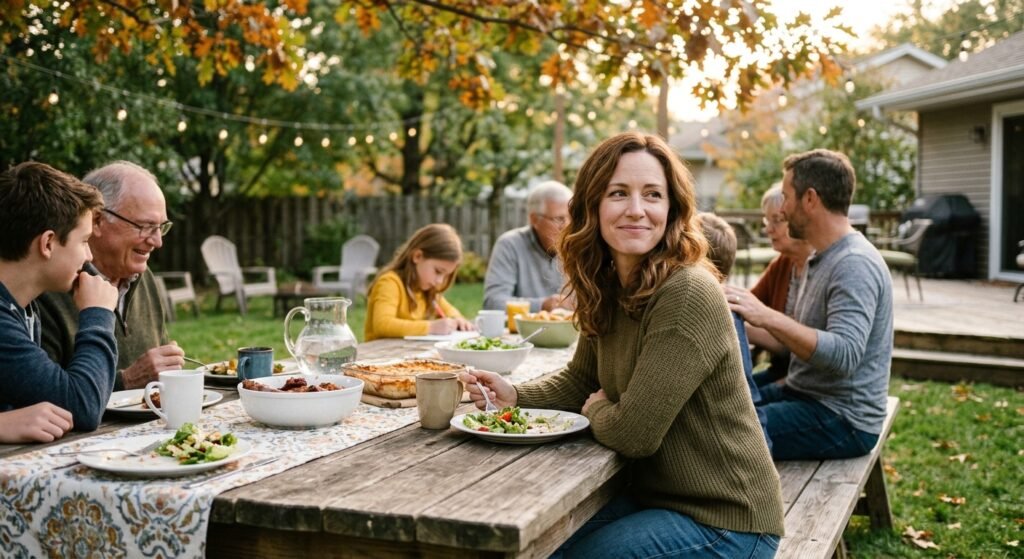
If you’ve ever spent a holiday gathering sitting slightly back from the main circle, watching the kitchen chatter unfold like a familiar play, you know the exact moment someone eventually approaches you with a look of mild concern. They ask if you’re doing okay, or if you’re bored, or if you need anything. It’s a sweet question, but it usually comes from a place of assuming that because you aren’t performing, you must be suffering. In reality, you’re probably having a perfectly lovely time just watching the room breathe.
There’s a quiet luxury in being the relative who doesn’t require a lot of coordination. You’re the one who doesn’t need the seating chart rearranged, who doesn’t have a list of conversational landmines to avoid, and who is happy to eat whatever is served. Over the years, your family has quietly categorized you as uncomplicated. While others are busy managing their reputations or navigating old rivalries, you’ve found a way to occupy a corner of the room that feels entirely your own.
The Hidden Roles We Play
Many of us grow up believing that to be valued in a family, we have to offer something dramatic. We think we need to be the successful one, the funny one, the protector, or even the one whose life is a constant, fascinating crisis. We treat family gatherings like a stage where we must justify our spot at the table. But when you step back from that pressure, something interesting happens. You realize that you don’t actually have to buy your way into the room with achievement or entertainment.
Psychologists who look at how families function often talk about the concept of low emotional reactivity. It’s a way of describing people who can be present in a room full of tension without catching the energy like a cold. When you’re uncomplicated, you aren’t ignoring the people around you; you’re simply choosing not to get swept up in the undertow of their expectations. You’re participating on your own terms, which is a surprisingly rare form of emotional maturity.
Studies on social dynamics suggest that every group needs these stabilizing presence points. Without the people who are content to simply listen, family systems can easily spin out of control under the strain of too many competing egos. Your quietness isn’t a lack of interest. It’s actually a form of generosity. You’re creating a safe space for others to relax because they don’t have to worry about how you’re going to react to them.
The Freedom of Being Low Maintenance
Being uncomplicated doesn’t mean you don’t have deep feelings, opinions, or boundaries. It simply means you’ve learned that not everything requires a public debate. You don’t feel the need to correct your uncle’s questionable trivia, and you don’t need everyone to validate your career choices before dessert. There’s an immense amount of energy saved when you decide that you don’t need to change anyone’s mind or prove your worth during a Sunday afternoon lunch.
We live in a culture that constantly urges us to make our presence felt, to stand out, and to claim our space. We’re told that if we aren’t being heard, we’re being forgotten. But there’s a different kind of strength in knowing you’re fine exactly where you are, even if you’re just the person who helps carry the dirty plates to the sink. It frees you from the exhaustion of constant self-presentation.
When you’re known as the quiet, easygoing relative, people often tell you their secrets. They sit next to you on the porch because they know you won’t judge them or offer unsolicited advice. You become a repository for the family’s gentler moments. They appreciate you not because you did something spectacular, but because you allowed them to just be themselves around you without any added complications.
A Different Kind of Success
Perhaps we’ve been measuring a successful life by the wrong metrics. We’ve been taught to look for big announcements, grand gestures, and crowded schedules. We think that peace is something we only get to experience after we’ve finished conquering everything else. But maybe peace is actually the starting point, not the finish line.
Choosing to be uncomplicated is a quiet decision to opt out of the competition for attention. It’s realizing that you don’t need to be the main character in every story to have a meaningful life. Sometimes, being the steady background character who keeps the lights on and the conversation flowing is more than enough.
The next time you find yourself at a crowded table, watching the chaos rise around you, you don’t have to feel like you’re failing because you aren’t adding to the clamor. You can take a sip of your drink, look around at the people you love, and enjoy the quiet comfort of your own uncomplicated corner. Maybe you aren’t missing out on the excitement. Maybe you’ve simply realized that a peaceful life is its own kind of victory, and you’re already exactly where you need to be.