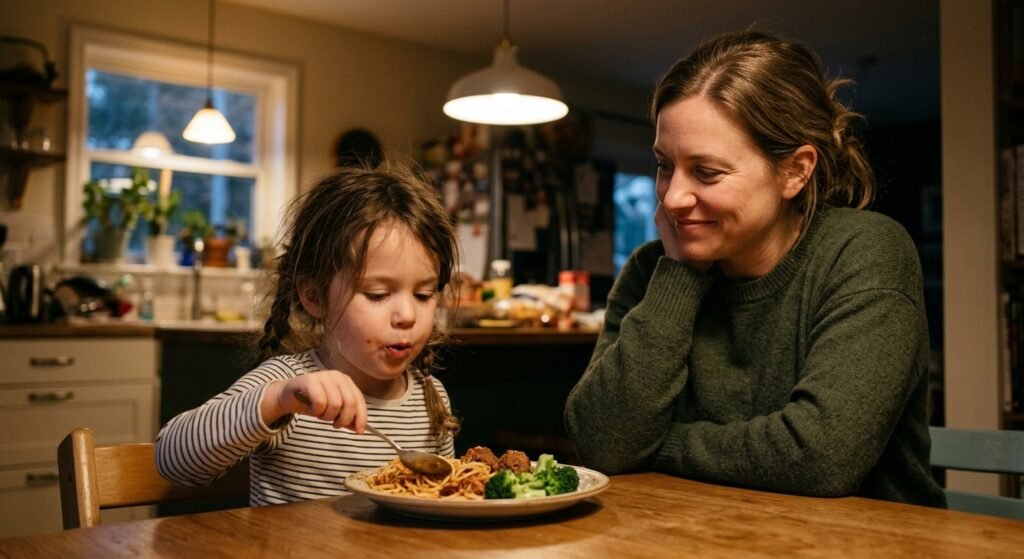
It usually happens in the middle of the kitchen chaos, when the floor is covered in crumbs and the sink is piled with dishes. You look across the table and watch your child take a bite of toast, or carefully negotiate with a piece of broccoli, or simply drink a glass of milk with their eyes fixed on nothing in particular. It’s an entirely unremarkable scene, one you’ve witnessed hundreds of times before. Yet, every now and then, a sudden quietness washes over you as you watch them chew. You feel a soft, unexpected wave of comfort settle in your chest.
It’s a feeling that’s difficult to explain to anyone who hasn’t experienced it. It isn’t pride exactly, nor is it the simple satisfaction of completing a chore. It is something much older and more tender. It is the deep, quiet relief of knowing that, at least for this hour, the child you love is safely nourished. In a world that feels increasingly chaotic and unpredictable, this small act of feeding them becomes a physical anchor of safety.
The Silent Language of Safety
Think about how much of parenting is spent worrying about things you can’t control. You worry about their friendships, their future, the bumps they’ll encounter at school, and the inevitable hurts you won’t be able to protect them from. But when you place a warm bowl of soup or a plate of sliced apples in front of them, the vast, overwhelming task of caregiving shrinks down to a manageable size. For those twenty minutes, you can see the direct result of your love. They are sitting down, they are warm, and they are being sustained by your efforts.
There’s a reason this moment feels so emotionally resonant. From our very first moments, food and safety are inextricably linked. Early developmental psychology suggests that our entire foundation of trust in the world is built around these early exchanges of nourishment. When a child is fed, they aren’t just absorbing vitamins; they are receiving a message that they are cared for, that their needs matter, and that they are safe. As parents, we feel this deeply because feeding is our most ancient way of saying, “I’ve got you.”
The Science of a Shared Table
Those who study family dynamics and emotional regulation have found that the simple predictability of a meal does something remarkable to our biology. When parents watch their children eat, their own nervous systems experience a measurable reduction in stress. It’s a biological feedback loop. The sight of a nourished, content child signals to our ancient brain that the immediate threat level is zero. The shelter is secure, and everyone is safe for now. It is a quiet reassurance that whispers that we are doing okay.
This quiet gratitude is particularly sweet on the days when parenting feels like an endless series of negotiations and minor defeats. Maybe it was a day of tantrums, or a day where you felt like you were failing at every single turn. You didn’t handle the morning rush well, you lost your temper in the car, and you felt the nagging worry that you’re somehow getting this all wrong. But then evening arrives. You put a plate down, they take a bite, and the clutter of the day fades. The messy reality of the kitchen doesn’t matter anymore. You realize that despite all the mistakes of the last twelve hours, you’ve met their most fundamental need.
The Smallest Acts of Love
We often think we need to throw perfect birthday parties or orchestrate grand family vacations to give our children a beautiful life. We try so hard to build a fortress of perfect memories, hoping it will protect them from the harsh realities of growing up. But perhaps the moments that shape them the most are the ones we barely think to document. It’s the grilled cheese sandwich on a quiet afternoon, the sliced fruit handed to them while they play, or the quiet breakfast before the school bus arrives.
Maybe we aren’t just relieved because our children are eating. Maybe we’re grateful because, in a world where we can’t protect them from every future hardship, feeding them is the one place we can look at and say, “Right now, you have everything you need.” It’s a quiet understanding that we don’t have to be perfect to be exactly what they need. And as you watch them finish their meal and run off to play, leaving behind a sticky table and a pile of crumbs, you realize that this ordinary moment of relief is actually the most extraordinary gift of all.