If you’ve ever bought a young child a beautifully wrapped, expensive toy only to watch them spend the next three hours playing with the cardboard box it came in, you’ve witnessed a strange kind of magic. While you’re standing there worrying about the money spent or the clutter on the living room rug, they’re busy sailing a pirate ship across the carpet.
To them, the box isn’t a piece of recycling. It’s a castle, a spaceship, a cozy cave, or a canvas for drawing. They don’t look at it and see what it cost or what needs to be cleaned up. They see what it could be right now, in this exact moment, without any expectations. They’re entirely present with what’s right in front of them.
As adults, we often lose that ability to see our world with fresh eyes. We get so caught up in the schedules, the endless lists, and the quiet pressure of what comes next that we start rushing past the very things that used to make us smile. We’ve traded curiosity for efficiency, and in doing so, we’ve quietly misplaced our sense of wonder.
The Cost of Efficiency
It’s easy to look at children and assume their joy comes entirely from having fewer responsibilities. We tell ourselves that it’s easy to be happy when you don’t have to pay bills, fold laundry, or worry about job security. But that explanation misses something important about how our minds actually work. The difference isn’t just about what’s on our schedules. It’s about where we keep our attention.
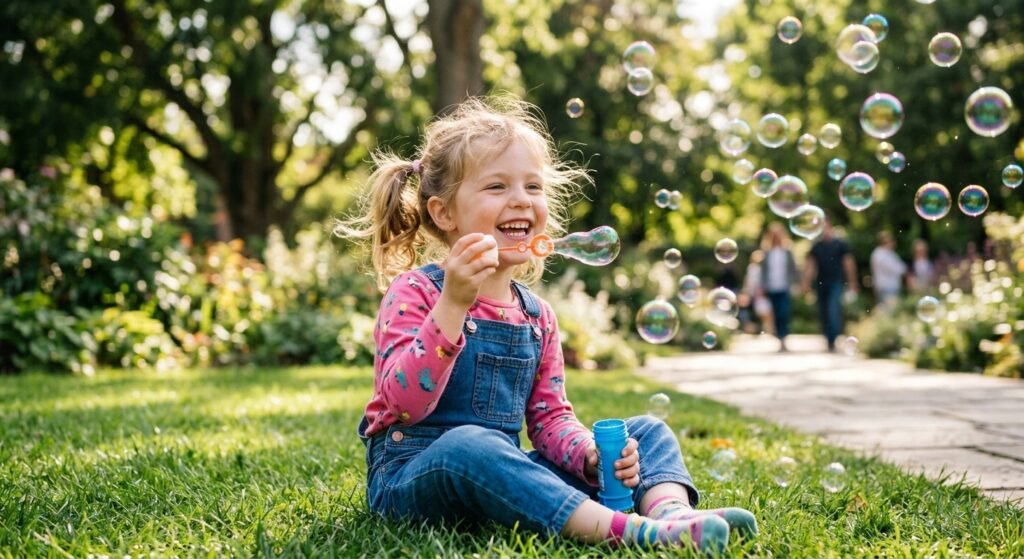
Think about the last time you walked through a park. You were probably thinking about a work email, planning dinner, or mentally rehearsing a conversation you need to have tomorrow. Your feet were on the path, but your mind was miles away, solving problems that hadn’t even happened yet. Meanwhile, a child on that same path is stopping to touch the rough bark of a tree, chasing a butterfly, or stomping in a puddle just to watch the water splash.
We’ve trained ourselves to look past the present to secure the future. It’s an important skill, of course. It’s how we build careers, maintain homes, and take care of our families. But when we spend all our time planning for what’s next, we lose the capacity to enjoy what’s now.
Why We Stop Seeing the World
There’s some fascinating research on how our brains process information as we grow older. Psychologists often point out that young minds operate with high sensitivity to local details, while adults tend to look for patterns and shortcuts. When we’re young, our brains are constantly absorbing everything because it’s all brand new. We look at a leaf and notice its tiny veins, its bright green color, and the way it moves in the breeze.
As we get older, our brains become highly efficient at categorizing the world to save energy. We see a leaf, label it “leaf,” and immediately move our focus to something else. We stop seeing the leaf itself because we already know what it is. This mental shortcut helps us navigate a busy world without getting overwhelmed, but it also means we quietly stop noticing the beauty hiding in plain sight.
It’s a necessary transition for survival, but it comes at a cost. We begin living in a world of labels rather than a world of experiences. We look at the sky and see the forecast instead of looking at the clouds and seeing shapes.
The Art of Staying Still
What children do so beautifully is resist those labels. They don’t need things to be useful to find them interesting. They can spend twenty minutes watching an ant carry a crumb across the driveway because they aren’t trying to optimize their time. They aren’t wondering if this is the most productive way to spend an afternoon.
For them, the present moment isn’t a stepping stone to something else. It is the destination.
When we’re around children, we’re often forced to slow down to their speed. You can’t easily rush a child who has found a particularly shiny pebble on the sidewalk. You have to wait. And if you let yourself, you might find that the pebble really is quite beautiful. You might remember, just for a second, what it felt like to believe that the world was full of tiny treasures waiting to be discovered.
Joy Doesn’t Require a Plan
It’s not that we don’t want to feel that way anymore. Most of us are desperate for a little more simplicity in our lives. But we’ve been conditioned to believe that happiness is something we have to earn, plan, or purchase. We wait for the vacation, the weekend, the promotion, or the perfect evening out to finally relax and feel good.
We’ve turned joy into a project we have to manage, rather than something we can find right where we are. We think we need the perfect conditions before we can allow ourselves to feel happy.
But the truth is that the big milestones we work so hard to reach are rarely where our best memories live. When you look back on your own life, the moments that feel warmest are often the most ordinary ones. It’s the memory of sharing a silly joke with a friend, the feeling of cold grass on bare feet on a hot day, or the comfort of a quiet morning with a warm mug in your hands.
Perhaps the real secret children keep isn’t that they have fewer worries, but that they know how to let joy find them without demanding that it look a certain way. They don’t require life to be perfect before they decide to enjoy it. They find wonder in the cracks of the sidewalk and the cardboard boxes because they haven’t learned to look past what’s right in front of them.
Maybe we don’t need to learn how to be happy. Maybe we just need to remember how to stop ignoring the things that already are. The world hasn’t actually lost its magic since you grew up. The puddles are still wet, the trees are still tall, and the clouds still look like ancient castles if you look at them long enough. You don’t have to search for wonder in some far-off place. It’s still right here, waiting for you to put down your worries, look down at the ground, and notice what’s already waiting to be found.