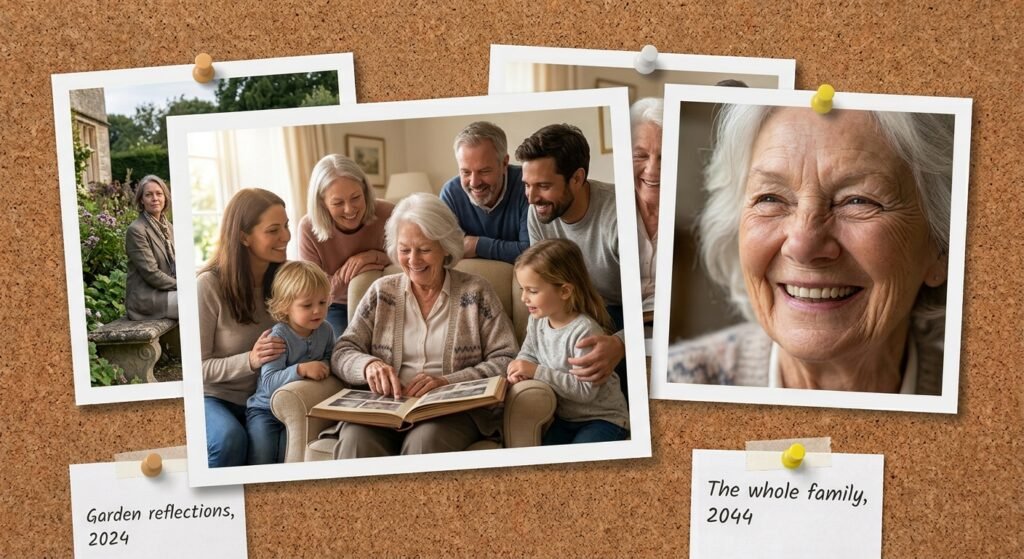
If you’ve ever sat around a kitchen table with your grown children, you’ve probably witnessed a strange kind of magic. The conversation turns to childhood memories, and suddenly, you feel like you’re listening to stories about someone else’s life. Your oldest child remembers a home with strict schedules, perfectly organized folders, and a parent who panicked if bedtime was delayed by ten minutes. Your youngest laughs, shaking their head, and describes a completely different reality where rules were suggestions, dinners were occasionally made of popcorn, and bedtime was whenever everyone got tired.
You sit there, listening to them debate, and realize they aren’t just remembering different events. They are remembering different parents. The person who raised your firstborn is a stranger to the person who raised your last. It’s a disorienting realization that can easily invite a quiet wave of guilt. You might wonder if you were too hard on the first, or perhaps too hands-off with the last. You might feel as though you failed to offer them a consistent anchor.
But if we look closer at these dinner table debates, we find something much deeper than a set of changing house rules. We find the story of our own growth. When we become parents, we don’t arrive fully formed. We learn how to do the job by doing it, which means our children are not just growing up. They are watching us grow up, too.
The Terrified Pioneer and the Softened Veteran
Think back to the early days with your first child. Everything felt high-stakes. Every fever felt like an emergency, every milestone felt like a test, and every parenting book on your nightstand was a manual you had to memorize to keep a small person safe. You had to prove to the world, and mostly to yourself, that you could handle this. This pressure often made you rigid. You held on tightly because you didn’t yet know which details actually mattered and which ones you could let go.
By the time your later children arrived, your perspective had altered. You had survived the sleepless nights, the toddler tantrums, and the sudden scares. You realized that children are remarkably resilient. The frantic energy of your early parenting years was replaced by a quiet confidence. You stopped policing every stray crumb and started focusing on the atmosphere of your home. You became softer, more patient, and far more willing to choose your battles.
This transition isn’t a sign of laziness or favoritism. Experts who study family dynamics point out that parental development is a continuous process. Research on parenting styles suggests that as mothers and fathers gain experience, their feelings of self-efficacy rise. This increase in confidence naturally lowers anxiety and reduces the need for hyper-vigilant control. You didn’t care less with your younger children; you simply knew more about what was worth your energy.
Sharing Different Seasons of a Life
Our children don’t just experience different parenting styles. They experience us during completely different seasons of our lives. Your oldest might remember a parent who was working two jobs, stressed about the mortgage, and struggling to find their footing in the world. They knew you when your future was uncertain and your resources were stretched. They watched you navigate the messy, loud, and often overwhelming climb of early adulthood.
Your youngest, however, might meet you when your career has stabilized, your finances are steadier, and your priorities have settled. They get a version of you that has more room to breathe, more time to sit on the porch, and more wisdom to offer. They don’t know the anxious climber; they know the person who has already reached the plateau and has time to look at the view.
It is easy to look at these differences and feel a sense of unfairness. We worry that our oldest got the short end of the stick, or that our youngest missed out on our highest levels of physical energy. We carry the burden of these comparisons, wishing we could have given every child the perfect blend of youthful energy and mature patience. But life doesn’t work in neat packages, and neither does love.
The Gifts in the Gaps
The truth is that each version of you offered something unique and necessary. Your oldest child grew up with a parent who was a partner in adventure. Together, you figured out how to build a family from scratch. You shared the raw, exciting, and terrifying firsts. That child got to see your ambition, your grit, and your determination to succeed. They learned how to navigate a world that doesn’t always have the answers, because they watched you do exactly that.
Your younger children received the gift of your peace. They got a parent who had already made the mistakes and wasn’t afraid of them anymore. They benefited from your willingness to slow down, your capacity for grace, and your understanding that childhood is brief. They got to rest in the security of a parent who had already figured out who they were.
Neither of these versions is superior to the other. They are simply different chapters of the same book. If you had tried to be the seasoned, relaxed parent with your firstborn, you might have felt lost without the structure. If you had tried to keep the rigid, high-anxiety rules with your last, you would have missed the joy of simply enjoying their presence.
Growing Together
When we look back on the parent we used to be, it is easy to feel a pang of regret. We wish we had known then what we know now. We wish we could go back and whisper to our younger selves that everything was going to be fine, that the spilled milk didn’t matter, and that we didn’t need to be so terribly hard on ourselves.
But perhaps the sibling arguments about who had the better childhood are missing the point. Those differences aren’t a sign of parenting mistakes. They are a beautiful testament to a life lived in motion. They mean you didn’t stay stuck. They mean you listened, you adapted, you fell down, and you got back up.
Maybe you didn’t give one child a worse version of yourself. Maybe each child simply met you at a different stop on your own journey of growing up. And maybe the version of you they got wasn’t a mistake at all, but the exact person you needed to be to help them become who they are today.