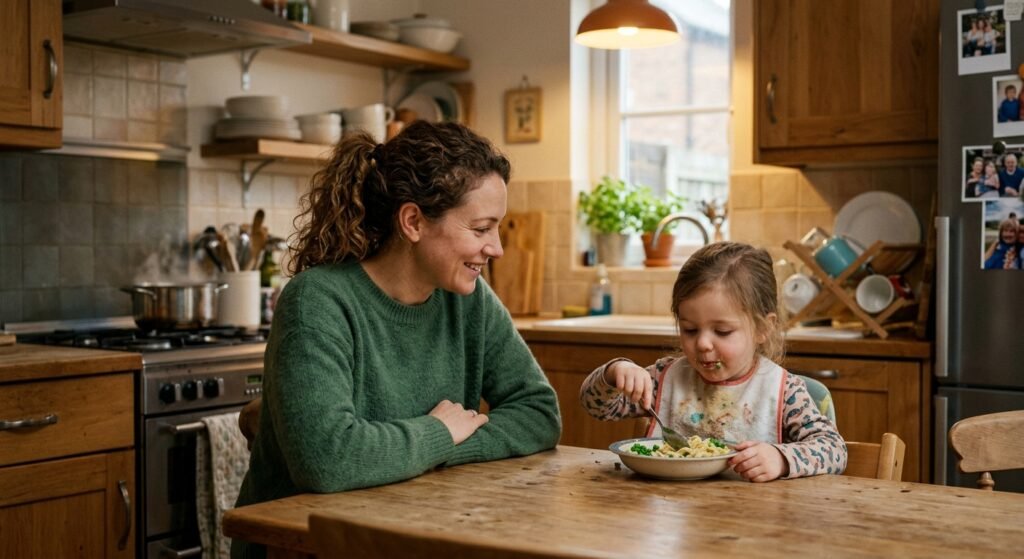
There is a specific kind of quiet that settles over a kitchen when a child is eating. It’s not the silence of an empty house, but the soft, rhythmic sound of a fork clicking against a plate, the gentle chewing, and the casual reach for a cup of water. If you’ve ever sat across from a small person and watched them comfortably finish a meal, you might not think twice about it. It feels like one of the most ordinary scenes in the world.
But for some people, that ordinary scene is nothing short of a miracle. They sit just a few feet away, holding their breath, trying not to make sudden movements or say anything that might break the spell. They watch the food disappear with a feeling that sits somewhere between profound relief and quiet awe. To the rest of the world, it’s just dinner. To them, it’s a moment where the world finally feels safe.
The Silent Worry of the Untouched Plate
Every parent understands the basic desire to feed their child, but the emotional depth of that responsibility goes far deeper than simply checking off a box on a daily checklist. When a child doesn’t eat, or can’t eat, the kitchen table stops being a place of connection and becomes an arena of intense anxiety. You find yourself measuring your success as a caregiver by the millimeter of milk left in a bottle or the exact number of peas left on a plate.
We don’t talk enough about the quiet panic of the parent whose child struggles with food. It might be a toddler going through an intense phase of sensory avoidance, a child navigating a medical recovery, or the lingering memory of times when filling the pantry wasn’t a guarantee. In those seasons, every mealtime feels like a test you are quietly failing. You stare at the untouched food and feel a deep, physical ache, wondering if you’re doing enough to protect the people who rely on you most.
That’s because feeding those we love is our most ancient way of saying “I care for you and I will keep you secure.” When that flow of care is interrupted, it shakes your sense of security to the core. You carry that anxiety with you throughout the day, a constant background hum that colors every other interaction.
The Ancient Language of Nourishment
Psychologists who study family dynamics often point out that food is rarely just about calories. It’s our first point of contact with safety and trust. From infancy, being fed is synonymous with being comforted. When parents struggle to feed their children, or when children have complex relationships with eating, it triggers a primal distress signal in both the adult and the child.
Some fascinating developmental research suggests that parents actually experience a physiological relaxation response when they see their child eat. It’s a natural signal that the immediate threat of deprivation has passed. When that plate is cleared, your nervous system finally gets the message that it can stand down. You aren’t just watching a child consume nutrients; you’re watching your own safety net be rebuilt in real time.
This explains why the relief of a good meal can feel so overwhelming. It isn’t just about nutrition; it’s about the restoration of order. It’s the physical proof that, at least for this hour, everything is going to be okay.
What Looks Ordinary Can Be Extraordinary
It’s easy to look at another family’s routine and make assumptions. You see a parent casually tossing half-eaten chicken nuggets into the trash and think nothing of it. But if you’ve ever spent months consulting specialists, crying in grocery store aisles, or stretching a tight budget to make sure there was enough on the table, you see that same scene through a very different lens. You realize that peace of mind is a luxury that isn’t distributed evenly.
The realization isn’t that we should feel guilty for taking an easy mealtime for granted. Rather, it’s that we never truly know the mountain someone else had to climb to reach a moment of simplicity. The parent who looks completely unbothered by her child asking for seconds might actually be fighting back tears of gratitude because, for the first time in a year, her child is actually feeling hungry.
When we recognize this, our perspective on our own daily struggles begins to soften. We start to see the ordinary routines of our days not as chores to be rushed through, but as quiet victories. A messy highchair tray, a child asking for a snack right before bed, a cleared plate—these aren’t just moments of daily life. They are proof of safety, abundance, and care.
The Quiet Safety of the Present Moment
If you’re currently in a season where mealtime feels like a battleground or a source of deep worry, it’s okay to feel tired. You aren’t failing; you’re navigating one of the most tender, exposed parts of caring for another person. The anxiety you feel is simply the flip side of your immense love.
And if you’ve recently crossed over to the other side, where the plates are empty and the worries have finally begun to fade, take a moment to breathe it in. Let yourself feel the sheer magnitude of that simple, beautiful sight of a child who is full, content, and safe. You don’t have to explain your gratitude to anyone else. It’s enough to sit there in the warm light of the kitchen, listening to the soft scraping of the fork, and know that you aren’t the only one who has found peace in a clean plate.